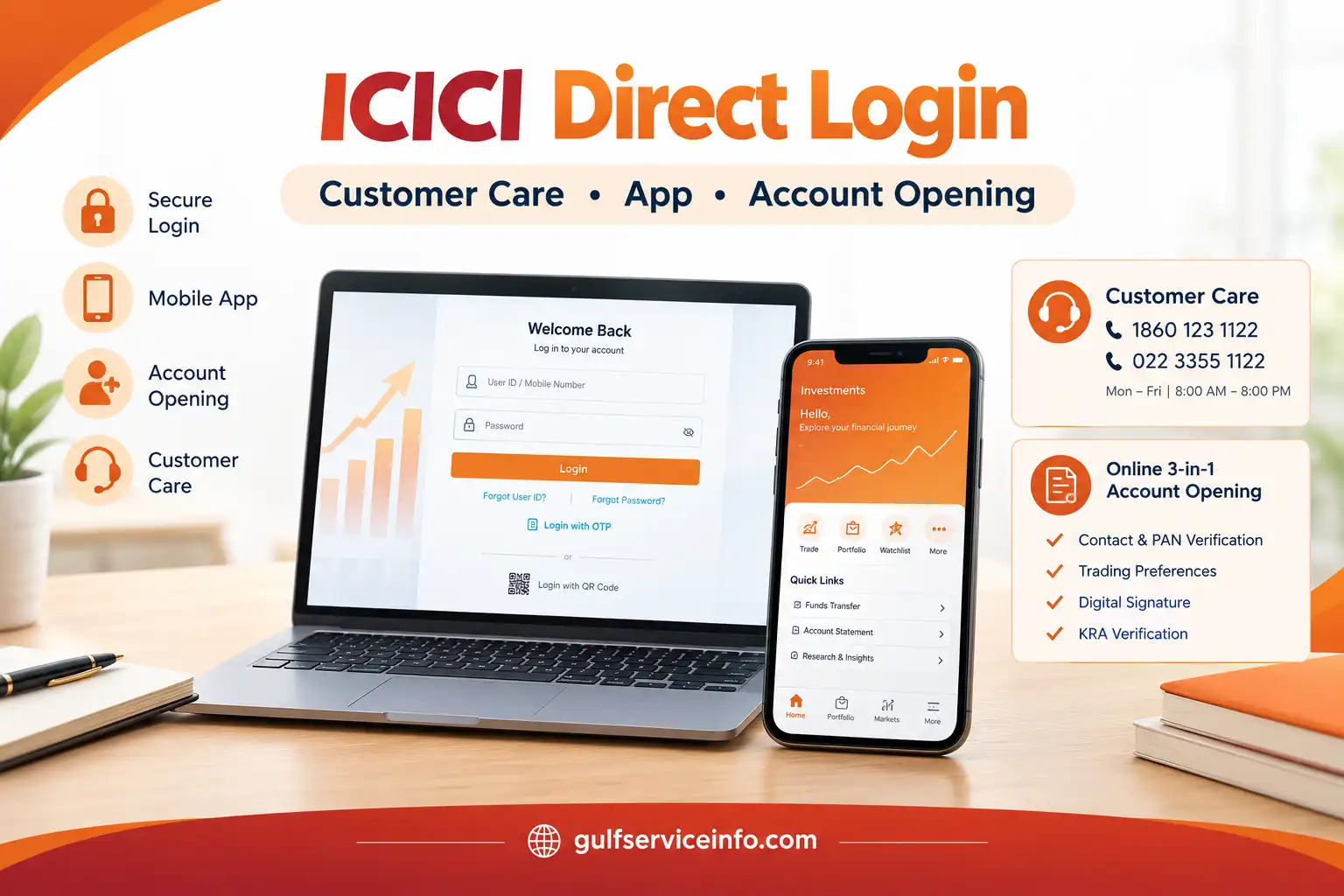
ICICI Direct Login: Customer Care, App, Account Opening & Complete Guide

Published On: September 26, 2026
Follow Us
ICICI Direct Login, Customer Care, App, Account Opening and Account Opening Guide

Accessing the right ICICI Direct login page is important if you want to manage your trading account, investments, mutual funds, portfolio or other online services securely. ICICI Direct provides web and mobile access, with authentication options that can include User ID, registered mobile number, OTP, TOTP and QR-based login.

Along with login access, many customers search for ICICI Direct account opening, the ICICI Direct app, customer care, office information, SIPs and mutual fund services. This guide brings these commonly searched services together in one place and explains how to use them without relying on unfamiliar third-party login links.

What Is ICICI Direct?

ICICI Direct is the online investment and trading platform operated by ICICI Securities. Through its website and mobile application, customers can access services covering areas such as equity trading, derivatives, mutual funds, IPOs and portfolio management.

The platform can be accessed from a web browser or through the ICICI Direct app, depending on the service you need. Its authentication system supports different methods, including User ID, mobile number, OTP, TOTP and QR-based authentication.

ICICI Direct is also associated with a 3-in-1 account structure that can bring together banking, demat and trading services. Customers can start the account-opening process online, while branch-based assistance is available where required.

Key fact: The current ICICI Direct login interface includes both User ID and Mobile No. login options. It also provides a QR-based method through which customers can authenticate using the ICICI Direct app.

Before You Sign In: Use the Official ICICI Direct Website

For account security, begin your ICICI Direct login journey from the official website rather than clicking an unfamiliar login link received through a message, email or third-party page.

Official ICICI Direct website: icicidirect.com

This is particularly important when entering sensitive information such as your User ID, password, PIN or OTP.

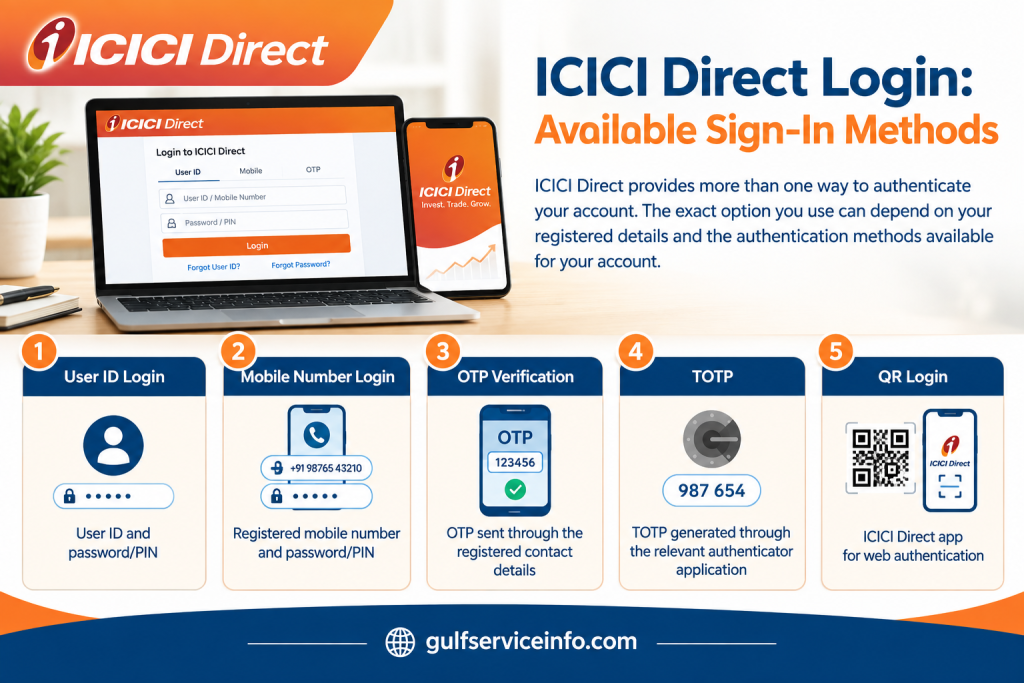
ICICI Direct Login: Available Sign-In Methods

ICICI Direct provides more than one way to authenticate your account. The exact option you use can depend on your registered details and the authentication methods available for your account.

Login methodWhat you may need
User ID loginUser ID and password/PIN
Mobile number loginRegistered mobile number and password/PIN
OTP verificationOTP sent through the registered contact details
TOTPTOTP generated through the relevant authenticator application
QR loginICICI Direct app for web authentication

The different options are designed to give existing customers flexibility when accessing their accounts while maintaining additional authentication for security.

How to Reach the ICICI Direct Login Page

The safest approach is to navigate directly through the official ICICI Direct website.

Follow these steps
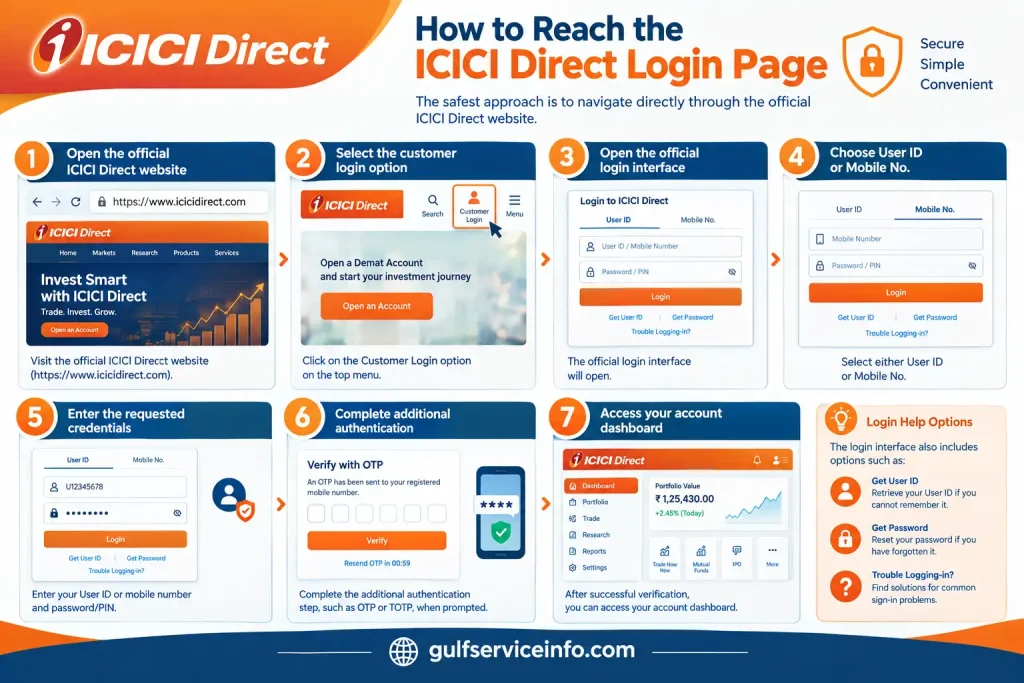
  • Open the official ICICI Direct website.
  • Select the customer login option.
  • Open the official login interface.
  • Choose User ID or Mobile No.
  • Enter the requested credentials.
  • Complete the additional authentication step, such as OTP or TOTP, when prompted.
  • After successful verification, you can access your account dashboard.
How to reach the ICICI Direct login page through the official website using User ID or mobile number and OTP or TOTP verification

The login interface also includes options such as Get User ID, Get Password and Trouble Logging-in? These can help when you cannot remember your credentials or encounter a sign-in problem.

QR-based web login

If you already use the ICICI Direct mobile app, the website also supports QR-based authentication. The web login page can generate a QR code that can be scanned through the relevant option in the ICICI Direct app.

This can be useful when you prefer to authenticate your browser session through the mobile application rather than manually entering all login details.

ICICI Direct Login With OTP

OTP verification can form part of the ICICI Direct login process as an additional authentication layer. Depending on the login journey available to you, you may first enter your normal credentials and then verify your identity using an OTP or TOTP.

How the OTP process works

Start by opening the official ICICI Direct login page and selecting the appropriate sign-in method. Enter your User ID or registered mobile number together with your password or PIN.

When prompted, enter the OTP received through your registered email address or mobile number. Where available, ICICI Direct also allows customers to use a TOTP generated through the relevant authenticator application.

Security reminder: Never disclose your OTP to another person. ICICI Direct states that it does not ask customers to provide confidential information such as passwords or OTPs through calls, SMS or email.

If an expected OTP does not arrive, check that your registered contact details are correct and allow some time for delivery. If the problem continues, use the available login-recovery or support options rather than repeatedly entering incorrect information.
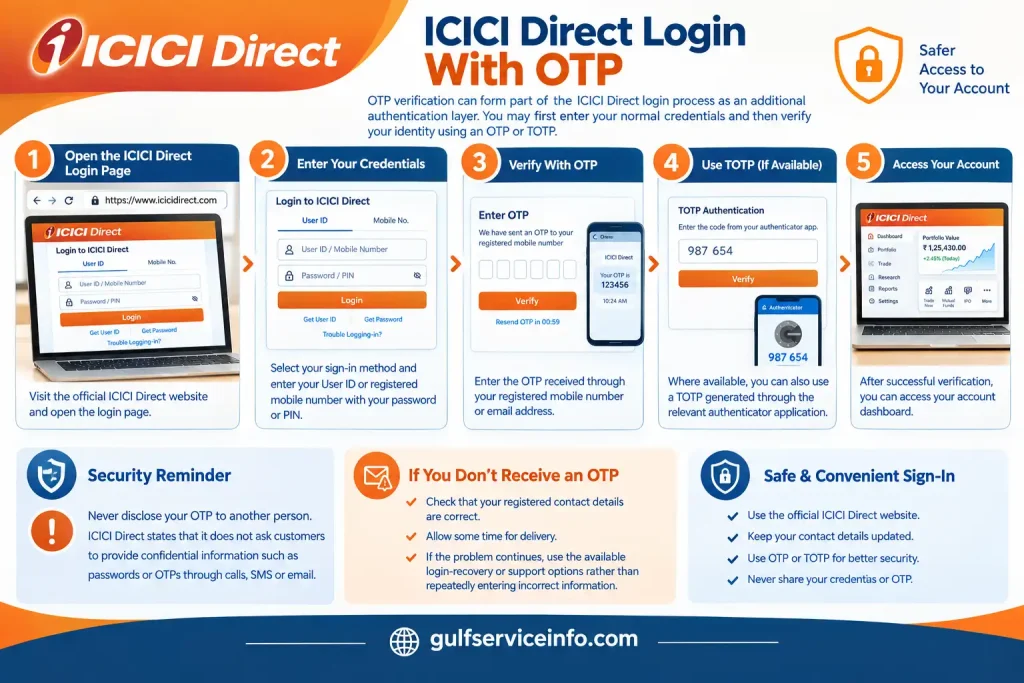
ICICI Direct Login with OTP verification, TOTP authentication, and secure account access

Can You Use Your Mobile Number for ICICI Direct Login?

Yes. The official login interface provides a Mobile No. option alongside User ID login. Customers with an eligible registered mobile number can use this method instead of entering their User ID.

Mobile-number login process
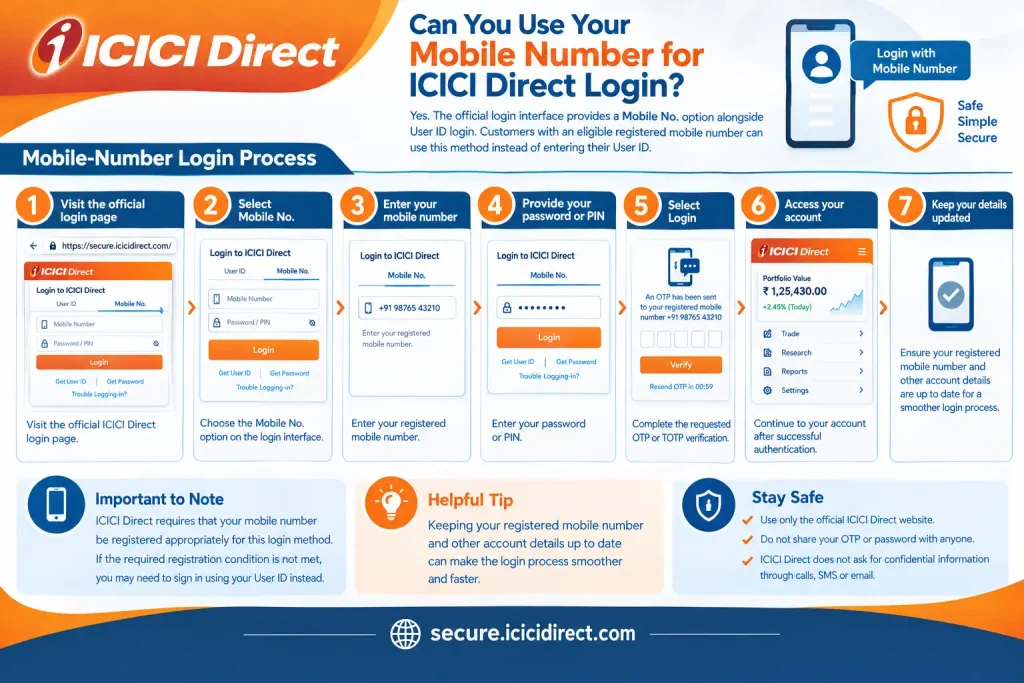
  • Visit the official ICICI Direct login page.
  • Select Mobile No.
  • Enter your registered mobile number.
  • Provide your password or PIN.
  • Select Login.
  • Complete the requested OTP or TOTP verification.
  • Continue to your account after successful authentication.
ICICI Direct login with mobile number showing the steps to select Mobile No., enter registered number, password or PIN, and complete OTP verification

ICICI Direct notes that the mobile number should be registered appropriately for this login method. If the required registration condition is not met, you may need to sign in using your User ID instead.

Keeping your registered mobile number and other account details up to date can therefore make the login process smoother.

ICICI Direct User ID Login and Password Recovery

The User ID route remains another available way to access your ICICI Direct account. Select User ID on the login interface, enter the required credentials and complete the additional authentication step shown for your account.

If you’ve forgotten your password, the website provides a Get Password option. The password-recovery process requires information such as your User ID and PAN, followed by CAPTCHA and OTP verification before you can create a new password.

First-time login

Customers with newly opened accounts may also need to generate their initial password. ICICI Direct provides a first-login process that uses details including the User ID, date of birth and PAN.

The exact prompts can vary according to the account-opening journey, so follow the instructions displayed on the official ICICI Direct website rather than relying on an old third-party guide.

Opening a New ICICI Direct Account Online

If you don’t already have an account, ICICI Direct provides an online account-opening journey through its website and app. Depending on your existing banking relationship, you may be guided towards an ICICI 3-in-1 account or another applicable account-opening process.

A typical online application can include mobile and email verification, PAN and Aadhaar verification, personal information, nominee details, KYC, Video KYC and digital signing.

What you need to do
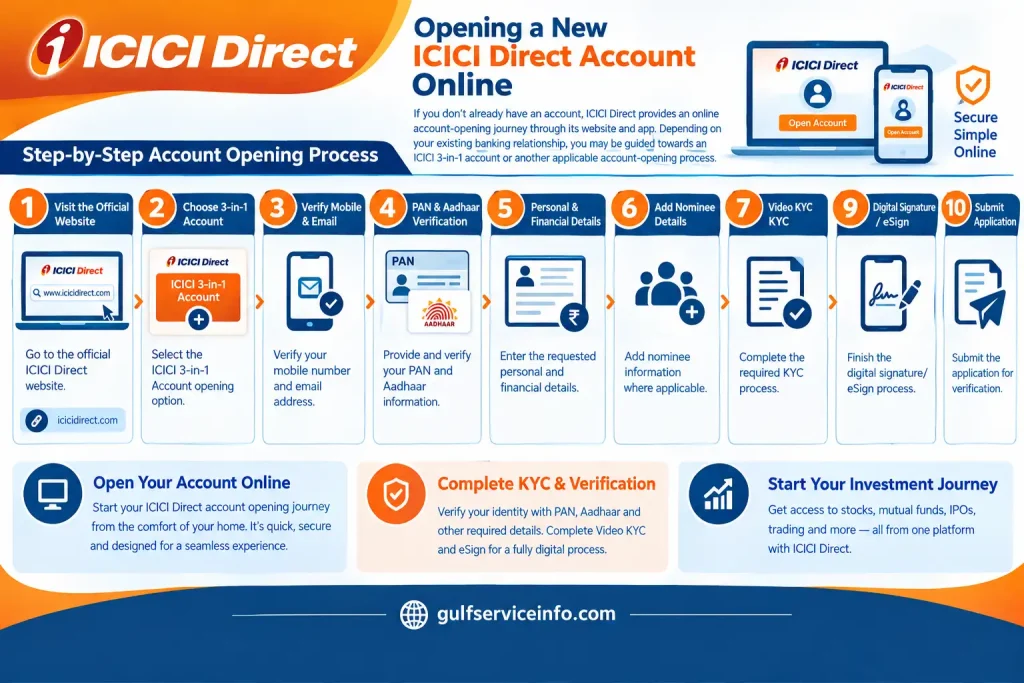
  • Visit the official ICICI Direct website.
  • Choose the ICICI 3-in-1 Account opening option.
  • Verify your mobile number and email address.
  • Provide and verify your PAN and Aadhaar information.
  • Enter the requested personal and financial details.
  • Add nominee information where applicable.
  • Complete the required KYC process.
  • Complete Video KYC when required.
  • Finish the digital signature/eSign process.
  • Submit the application for verification.
Opening a new ICICI Direct account online with steps for mobile and email verification, PAN and Aadhaar verification, KYC, Video KYC, eSign, and application submission.

Applicants who don’t already have an ICICI Bank savings account can use the New-to-Bank online journey. According to the supplied information, this process includes mobile and email verification, PAN and Aadhaar verification, personal details, nominee information, Video KYC and eSign.

Existing ICICI Bank savings-account customers may have relevant banking information used during the application journey. PAN and Aadhaar should be kept ready, while a signature may also be required depending on the records available.

What Happens After an ICICI Direct Account Application?

Submitting the online form doesn’t necessarily mean the account becomes active immediately. The application goes through the required verification and approval process, including the relevant exchange and KRA checks.

ICICI Direct states that approval usually takes up to two working days when the application is complete and there are no issues requiring additional action.

Some applications may not be completed entirely online. For example, problems involving Aadhaar or mobile details, name mismatches or certain bank-account conditions can require an offline process.

In such cases, customers can seek assistance through an eligible ICICI Bank or ICICI Direct branch and complete the remaining requirements there.

Using the ICICI Direct App

The ICICI Direct app lets customers manage their trading and investment activities from a mobile device, reducing the need to use the desktop website for routine account access. Depending on the services available to the account, users can view portfolios, monitor investments, place trades and access other ICICI Direct features through the application.

To begin, install the official ICICI Direct app from the appropriate app store and sign in with your registered account details. Avoid unofficial applications or third-party downloads, particularly when they request sensitive information such as your password, PIN or OTP.

Signing in through the ICICI Direct app

Once the application is installed, open it and provide your User ID or another supported login credential. The security check can vary according to the authentication method enabled for your account and may involve an OTP, TOTP, PIN or another verification step.

The mobile app can also support QR-based ICICI Direct login on the web. When a QR code is displayed during the browser login process, customers can use the relevant feature within the ICICI Direct app to scan it and authenticate the web session.

Security tip: Keep the app updated and install it only through its official app-store listing. Your login PIN, password and OTP should remain private.

ICICI Direct Customer Care and Support

ICICI Direct customer care can help with a range of account and platform-related concerns, including login difficulties, trading queries, demat services, technical problems and account-opening assistance. For the most reliable contact information, use the official customer-care section rather than telephone numbers or email addresses copied from unrelated websites.

Before contacting support, have the relevant details about your issue available. However, never disclose your password, PIN, OTP or other confidential authentication information to anyone claiming to represent customer support.

ICICI Direct also provides security guidance concerning fraudulent calls, emails and messages. Customers should be cautious of communications asking for confidential account information and should verify that they are using an official support channel.

Issues that may require customer support

Customer care can be relevant if you’re dealing with:

  • ICICI Direct login problems
  • Forgotten User ID or password
  • OTP or authentication difficulties
  • Trading-account questions
  • Demat-account issues
  • New account-opening assistance
  • Website or app technical problems
  • Questions about transactions or available services

Before raising a support request, check the official website for a relevant self-service option. Some credential and login issues can be resolved directly through the available online tools.

Is There an ICICI Direct Customer Care Number Available 24/7?

The phrase ICICI Direct customer care number 24/7 is commonly searched online, but customers should not assume that every support channel operates around the clock. Availability can depend on the service and communication method.

The safest way to find the current telephone numbers, contact options and applicable support timings is to check the official ICICI Direct customer-care page.

Check ICICI Direct Customer Care

Avoid relying on an old number found in a blog post, social-media comment or unrelated search result. Customer-service details can change, so the current information published by ICICI Direct should take priority.

Security reminder: Never provide your password, OTP, PIN or other confidential information to an unexpected caller, SMS sender or email contact claiming to be from ICICI Direct.

Contacting ICICI Direct Customer Care by Email

Email support can be useful when an issue needs a written explanation or when you need to provide more context about a problem. Since the appropriate email contact can depend on the type of query, check the current ICICI Direct customer-care page before sending your request.

ICICI Direct Official Customer Support

When writing to support, describe the problem clearly and include only information relevant to your query. For example, a login complaint can explain whether you’re receiving an incorrect-password message, not receiving an OTP or having trouble opening the login page.

Do not include your password, login PIN, OTP, CVV or other confidential authentication details in an email. Customer support should not require these secrets simply to understand or investigate a routine issue.

Finding an ICICI Direct Office or Branch

Customers who prefer face-to-face assistance can look for an ICICI Direct office or an appropriate ICICI branch through the official website. The correct location may depend on the service you need, so it’s sensible to confirm the available service before travelling.

Visit ICICI Direct

If you’re visiting for account opening, documentation or another specific request, confirm beforehand that the selected location handles that service. Different branches or offices may not provide exactly the same facilities.

Take the documents relevant to your request, but never hand over your password, PIN or OTP. Ordinary account assistance should not require you to disclose confidential login credentials.

How to Stop an ICICI Direct SIP

If you’ve started a mutual fund SIP through ICICI Direct and want to stop future instalments, first identify the active SIP within your account. The exact menu and cancellation process can vary depending on how the SIP was created and the mutual fund service currently being used.

A typical route is:
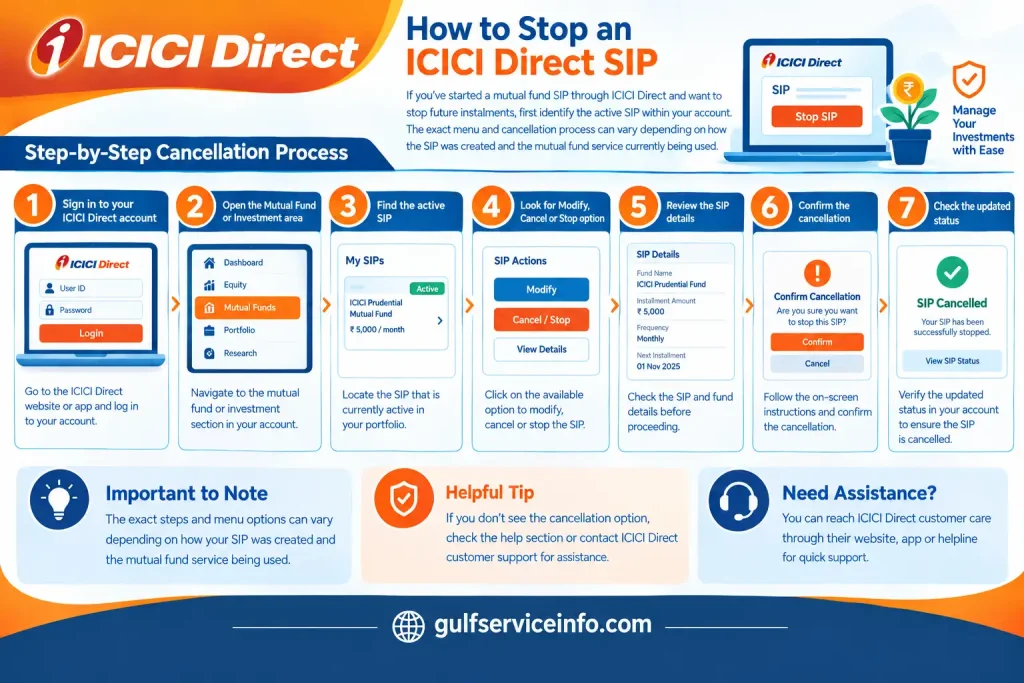
  • Sign in to your ICICI Direct account.
  • Open the mutual fund or investment area.
  • Find the SIP that is currently active.
  • Look for the available modify, cancel or stop option.
  • Review the SIP details before proceeding.
  • Confirm the cancellation instruction.
  • Check the updated status afterwards.
How to stop an ICICI Direct SIP online by signing in, finding an active SIP, selecting the cancel or stop option, confirming the cancellation, and checking the updated SIP status.

Stopping an SIP normally concerns future scheduled instalments. It does not automatically sell the mutual fund units you’ve already purchased. Redeeming existing units is a separate transaction and can involve its own tax, exit-load and other applicable conditions.

Because online menus can change, use the options currently displayed in your ICICI Direct account rather than depending on an old screenshot or third-party tutorial.

ICICI Direct Mutual Funds: Understanding Direct Growth

ICICI Direct provides access to mutual fund investments, including schemes that may be available in Direct Growth options. However, “Direct” and “Growth” describe particular characteristics of a mutual fund plan and option; they do not mean that every mutual fund investment made through ICICI Direct is automatically a Direct Growth investment.

A Direct Plan generally does not include the distributor commission structure associated with a Regular Plan. Growth refers to an option where returns are generally retained within the scheme and reflected in the investment’s value rather than being paid out as income.

Before placing an order, check the exact scheme, plan and option. It’s also useful to review the current investment objective, risk level, expense ratio and scheme documents because fund information and product structures can change.

Direct Growth and Regular Growth Compared

FeatureDirect GrowthRegular Growth
Plan typeDirectRegular
Distributor commissionGenerally not includedDistributor commission structure applies
Treatment of returnsReinvested within the schemeReinvested within the scheme
Investment routeInvestor invests directlyOften involves a distributor/intermediary
Investor supportDepends on the investor’s own knowledge and chosen servicesMay include distributor assistance

The choice between plans depends on the investor’s circumstances, preferences and level of familiarity with mutual fund investing. Historical performance should not be treated as a guarantee of future results.

ICICI Bluechip Fund Direct Growth

ICICI Bluechip Fund Direct Growth is a search phrase used by investors looking for the direct-growth version of the relevant ICICI Prudential mutual fund scheme. Before investing, verify the current official scheme name and the latest available fund information rather than relying solely on an older product name.

Important details to review include the scheme’s investment objective, portfolio, risk level, expense ratio, minimum investment requirements and applicable terms. These details can change over time, so current scheme documents should take precedence over historical information.

Also check that you are selecting the intended Direct or Regular plan and the appropriate investment option. Similar fund names can otherwise make it easy to select a different plan or option from the one you intended.

ICICI Technology Fund Direct Growth

The ICICI Technology Fund Direct Growth search term generally refers to a direct-growth mutual fund strategy focused on companies connected with the technology sector. Because a sector-focused fund concentrates on a particular area of the market, its performance can differ from that of a broadly diversified equity fund.

Before investing, review the latest scheme information, investment objective, sector allocation, riskometer and other disclosures associated with the specific fund. Technology-sector funds can be affected by factors such as company valuations, economic conditions, competition, business cycles and changes in technology demand.

Past performance should not be considered the sole basis for selecting a mutual fund. Your investment horizon, risk tolerance and existing portfolio allocation also matter when assessing whether a particular fund fits your circumstances.

ICICI Large and Midcap Fund Direct Growth

The ICICI Large and Midcap Fund Direct Growth search generally relates to a mutual fund strategy providing exposure to both large-cap and mid-cap companies. Combining these segments can give investors exposure to businesses of different market capitalisations, although the investment remains subject to equity-market risk.

When reviewing the scheme through ICICI Direct, check the latest portfolio, asset allocation, expense ratio, risk level and investment objective. The underlying holdings are not fixed and can change as the fund manager manages the portfolio.

Before investing, confirm the exact scheme name, plan and option shown on the current platform. This is especially useful when comparing Direct versus Regular plans or Growth versus other available options.

Common ICICI Direct Login Issues and How to Fix Them

An ICICI Direct login may fail for different reasons, such as incorrect credentials, an expired password, OTP delays, TOTP problems, browser errors or temporary technical issues. Before trying multiple solutions, identify which part of the sign-in process is causing the problem — your User ID, password, registered mobile number, OTP, TOTP or the ICICI Direct platform itself.

Login issueWhat you can do
User ID forgottenUse the official Get User ID recovery option
Password forgottenChoose Get Password and complete the verification steps
OTP not receivedCheck your registered mobile number/email and wait before requesting another OTP
Mobile-number login failingMake sure you are using the registered mobile number
TOTP not workingCheck your authenticator app and enter the current TOTP
Website not loadingRefresh the page or try another supported browser
App login problemUpdate the ICICI Direct app and try again
Account inaccessibleContact official ICICI Direct customer support

The ICICI Direct login area includes dedicated recovery options for customers who cannot remember their User ID or password, as well as support for login-related difficulties.

How to Reset an ICICI Direct Password

A forgotten password can be recovered through the Get Password option on the official ICICI Direct login page. The recovery process may ask for your User ID and PAN, followed by CAPTCHA and OTP verification before you can create a new password.

Always use the official ICICI Direct recovery process when resetting your credentials. Avoid entering your PAN, account details or other personal information on third-party websites offering password recovery.

What to Do When the ICICI Direct OTP Does Not Arrive

If your ICICI Direct OTP has not arrived, begin by checking whether the registered mobile number or email address is correct. Look through your SMS messages and email inbox, including any relevant filtered folders, and give the system some time before requesting another OTP.

Repeated OTP requests may not solve a delivery delay. If you still cannot authenticate after checking your registered contact details, use the official ICICI Direct support channels. Never disclose an OTP to someone who contacts you claiming to be able to resolve your account problem.

ICICI Direct App Login Not Working

When the ICICI Direct app does not open or the login screen is not functioning properly, first check your internet connection and confirm that you have the latest version of the application. Closing the app completely and reopening it can also resolve a temporary loading issue.

You can also try accessing ICICI Direct through its official website. If the website works while the app does not, the problem may be limited to the mobile application. If neither route works, check the official support channels for further assistance.

How Safe Is ICICI Direct Login?

The official ICICI Direct website and mobile application are the appropriate channels for accessing your account. ICICI Direct also supports two-factor authentication, which adds another verification step beyond your regular login credentials.

Your own security practices are equally important. Keep your User ID, password, login PIN, OTP and other authentication information private, even if someone claims to represent ICICI Direct.

ICICI Direct Account Security Checklist

For safer ICICI Direct login access:

  • Use the official ICICI Direct website when signing in through a browser.
  • Install the mobile app through the relevant official app store.
  • Check the website address before entering your login details.
  • Never disclose your password, OTP or authentication information to callers.
  • Avoid signing in through suspicious links received by SMS or email.
  • Keep your browser and ICICI Direct application updated.
  • Create a strong password and avoid using the same password on other services.
  • Sign out when using ICICI Direct on a shared or public computer.
  • Contact official customer support if you notice anything that suggests unauthorised access.

ICICI Direct also warns customers about fraudulent communications and advises them not to disclose confidential information such as passwords and OTPs through calls, SMS or email.

ICICI Direct Login and Account FAQs

ICICI Direct offers a broad range of investment and trading services, but there are also some limitations to consider. The main concerns raised in the supplied material relate to brokerage and other charges, platform usability, service responsiveness and the perceived value of its research and advisory features. These factors can matter differently depending on how frequently you trade and which services you use.

Brokerage and Other Charges

One commonly mentioned concern is the cost of using ICICI Direct compared with discount brokers that offer flat-fee brokerage models. Standard delivery and intraday charges may be higher unless an investor chooses an applicable prepaid or subscription-based plan, such as Prime or iValue.

There may also be charges associated with certain transactions or non-trading activities. Because the actual cost can depend on the selected plan and transaction type, investors should review the applicable brokerage and fee schedule before opening or actively using an account.

Trading Platform Experience

The user experience is another area mentioned in the supplied feedback. Some users describe the web and mobile platforms as relatively busy or less intuitive, particularly for people who prefer a simpler trading interface.

There are also user reports describing slowdowns or connectivity-related problems during periods of high market activity. Such experiences can vary, so they should be considered as user feedback rather than a universal description of the platform.

Customer Support and Research

Customer support is another consideration raised by users. The supplied material notes concerns about the availability of instant online assistance and reports of longer waiting times through some support channels.

ICICI Direct also provides research and advisory information, but opinions about the usefulness and reliability of its recommendations are mixed in the supplied sources. Investors considering these services should therefore review the research themselves and avoid treating advisory commentary as a guarantee of investment performance.

What Should You Check Before Choosing ICICI Direct?

Before deciding whether ICICI Direct meets your requirements, compare the areas that are most relevant to your investing or trading activity:

  • Brokerage: Check the charges applicable to your preferred transaction types and selected plan.
  • Other fees: Review the schedule for non-trading and transaction-related charges.
  • Platform: Consider whether the web and mobile interfaces suit the way you trade.
  • Support: Check the available customer-service channels and expected response options.
  • Research: Review the type of research and advisory information available and assess whether it matches your needs.

The importance of these factors depends on your own trading frequency, preferred platform, support expectations and investment approach. Reviewing the current charges and available services before making a decision can help you understand the practical costs and features of the account.

If you cannot withdraw money from ICICI Direct, the amount may not yet be available as free cash for withdrawal. Funds can remain allocated for trading, tied to open positions or temporarily unavailable while a transaction or deposit is being settled.

Common Reasons Your ICICI Direct Withdrawal May Fail

Several situations can prevent an amount from being withdrawn immediately:

  • Funds are still allocated for trading: Money held in a trading allocation may not appear as withdrawable cash. You may need to de-allocate or reduce the allocation through the ICICI Direct app before attempting the withdrawal again.
  • A recent share sale is still settling: If you have recently sold shares, the proceeds may take one working day to reflect in your cash allocation and become available for withdrawal under the stated T+1 settlement process.
  • Margin or F&O requirements are blocking funds: Open futures and options positions, as well as applicable peak-margin requirements, can restrict the amount available for withdrawal. In such cases, the platform may display a message such as “Debit Peak Margin Now”.
  • A cheque deposit has not cleared: Money deposited through a cheque may remain unavailable until the cheque-clearing process has been completed.

What to Check Before Trying Again

First, check your available cash rather than only the overall account balance. If the amount is allocated to trading, review whether it needs to be de-allocated; if it comes from a recent sale or cheque deposit, allow the relevant settlement or clearing process to finish.

If the funds still cannot be withdrawn after these conditions have been addressed, check the current withdrawal instructions and support options provided by ICICI Direct before attempting further transactions.

If you cannot sell shares through ICICI Direct, the issue may be related to demat authorisation, the way the order is placed, settlement timing or restrictions on the holding. In some cases, the shares may appear in your account but still not be available for a delivery sale.

Common Reasons an ICICI Direct Share Sale May Fail

The following issues can prevent a delivery holding from being sold:

  • Demat authorisation is incomplete: For shares held in a CDSL demat account, a delivery sale may require authorisation through a CDSL TPIN and OTP. Where applicable, an NSDL holding may use a Power of Attorney arrangement for the required authorisation.
  • The wrong product type is selected: Delivery holdings generally need to be sold using the applicable Cash Sell or Delivery/CNC option. Selecting Intraday (MIS) or a margin product when there is no corresponding intraday position can cause the order to be rejected.
  • Recently purchased shares have not settled: Shares bought recently may still be within the T+1 settlement cycle or may not yet have appeared in the relevant active trading or demat balance. In that situation, the holding may not immediately be available for sale.
  • The shares are pledged: Shares pledged against a margin or loan facility may be restricted from sale until the pledge is released. Check whether the holding is marked as pledged before attempting another sell order.
  • The shares belong to a special portfolio: Holdings purchased through features such as Stock Baskets or One Click Equity may need to be exited through the relevant portfolio section rather than through the standard cash-sell route.
  • Trading restrictions apply: A stock may be temporarily unavailable for normal selling if it is locked in an upper or lower circuit or has been suspended from trading by the exchange because of applicable regulatory restrictions.

What Should You Check First?

Start by checking whether the shares are actually available for delivery sale and whether the required demat authorisation has been completed. Then confirm that you have selected the correct selling product and that the shares are not still settling, pledged or held within a portfolio that requires a separate exit process.

If the stock is subject to a trading restriction or exchange suspension, changing the order type will not resolve the issue. In that situation, check the relevant restriction and the current trading status before trying again.

Whether Zerodha or ICICI Direct is better depends on what you need from a broker. Zerodha may suit investors and traders who prioritise lower brokerage and a simple trading platform, while ICICI Direct may appeal to users who want a 3-in-1 banking, trading and Demat setup along with research and advisory services.

Zerodha vs ICICI Direct: Direct Comparison

FeatureZerodhaICICI Direct
Broker TypeDiscount BrokerFull-Service Broker
Equity Delivery₹0 brokerageFlat or percentage-based, depending on the plan
Intraday / F&OFlat ₹20 per executed orderFlat ₹20 under the Neo Plan or higher under other plans
Account TypeTrading + Demat3-in-1: Bank + Trading + Demat
Research & TipsNot provided as a standard advisory serviceResearch reports and advisory services available
Trading PlatformKite, with a clean and modern interfaceFeature-rich platform integrated with ICICI services

When Zerodha May Suit You

Zerodha may be suitable if your main priority is keeping brokerage costs low, particularly for long-term equity delivery investments. Its Kite platform is also designed for users who prefer a straightforward and modern trading interface.

You may consider Zerodha if you:

  • Want zero brokerage on equity delivery.
  • Prefer a clean and modern trading platform.
  • Make your own investment decisions and do not require regular advisory recommendations.
  • Want a discount-broker model focused primarily on trading and investing.

When ICICI Direct May Suit You

ICICI Direct may be more suitable if you prefer having your banking, trading and Demat services connected through a 3-in-1 account. It can also be useful for investors who want access to research reports and advisory-related services alongside their trading account.

You may consider ICICI Direct if you:

  • Want a 3-in-1 Bank + Trading + Demat account.
  • Prefer having banking and investment services connected in one ecosystem.
  • Want access to research reports and advisory recommendations.
  • Use features such as margin against shares or other banking-linked investment services.

Zerodha or ICICI Direct: Which One Fits Your Needs?

The choice between Zerodha and ICICI Direct mainly comes down to your preferred brokerage model, account setup, trading platform and need for research or banking integration. Zerodha focuses on a discount-broker approach, while ICICI Direct combines brokerage services with a broader banking and investment ecosystem. Before choosing, compare the applicable brokerage plan, other charges, platform features and services you are likely to use.

Yes. Shares held in an ICICI Direct demat account can be moved to a Zerodha demat account without selling them first. Since the securities themselves are transferred rather than sold, the transfer does not by itself create a capital gain transaction.

There are two common ways to move the holdings: an off-market transfer while keeping the ICICI Direct account active, or a closure-cum-transfer if you want to shut the ICICI Direct demat account completely.

Ways to Move Your Shares

1. Off-Market Transfer

You can retain your ICICI Direct account and transfer selected shares to Zerodha. ICICI Direct may charge a fee for processing the transfer. According to the supplied information, Zerodha offers reimbursement of eligible transfer charges up to ₹30 per stock, subject to a maximum of ₹500.

2. Closure-Cum-Transfer

If you’re closing your ICICI Direct demat account, you can request a closure-cum-transfer of your holdings to Zerodha. The supplied information states that this method can be completed without a transfer fee.

How the Transfer Works

Before submitting a transfer request, check which depository your ICICI Direct demat account uses. ICICI Direct accounts may be held with NSDL or CDSL, while Zerodha uses CDSL.

If an offline transfer is required, you generally need to obtain a Delivery Instruction Slip (DIS) booklet from ICICI Direct. Enter the required Zerodha details, including the DP ID, Client ID/Beneficiary ID, ISIN of each security, and the quantity to be transferred. After signing the DIS, submit it through the applicable ICICI Direct branch or process prescribed by the depository.

For eligible CDSL accounts, an online transfer through CDSL Easiest may also be available, depending on the current account setup and depository permissions.

Before transferring: verify the Zerodha demat details and each security’s ISIN carefully. An incorrect DP or beneficiary detail can cause the transfer request to be rejected or delayed.

Yes, you can sell shares already held in your portfolio and purchase stocks on the same day. However, how the transactions are treated depends on whether you are buying back the same stock or choosing a different one, along with the settlement and cash-use rules that apply to your trading account.

If You Sell and Buy Back the Same Stock

Selling an existing holding and purchasing the same stock again during the same trading day can be treated as an intraday transaction.

A few points are worth keeping in mind:

  • Intraday classification: The sell and subsequent purchase of the same stock may be considered an intraday trade.
  • Existing average price: Your original holding’s purchase average generally remains unchanged because the long-term shares do not actually leave the depository account in the same way as a delivery sale.
  • Profit or loss: The price difference between the sale and repurchase is accounted for as an intraday profit or loss.

Selling One Stock and Buying Another

The situation is different when you sell one holding and want to use those proceeds to purchase a different stock on the same day.

In a standard cash account, the money generated from a sale may remain unsettled until the applicable settlement cycle is completed. Whether you can immediately use those proceeds for another purchase depends on your broker’s rules and the regulations of the market where you trade.

Cash versus margin matters: Using unsettled sale proceeds to purchase another security can create trading or settlement issues in some markets when the account does not provide margin or other permitted purchasing power.

Key Point

Selling and buying on the same day is possible, but the treatment isn’t identical in every situation. Before placing the second order, check whether you’re repurchasing the same security, buying a different stock, and whether the proceeds from your sale are available for immediate use under your broker’s settlement rules.

Yes, an ICICI Direct trading account can be closed online through the account section of the ICICI Direct website. The closure request is submitted digitally through the platform, followed by OTP verification and an Aadhaar-based e-sign process.

Before starting, make sure your account is ready for closure. Any open positions, remaining holdings, unpaid dues, or active investment instructions may need to be dealt with first.

Steps to Close Your ICICI Direct Trading Account Online

You can submit the closure request by following this route:

  1. Sign in to ICICI Direct using your account credentials.
  2. Open the Help (?) section from your account.
  3. Find the Self Help area and select New Service Request.
  4. Choose Trading Account Closure from the available service options.
  5. Review the closure consent and select I Agree to proceed.
  6. Complete the verification using the OTP sent to your registered mobile number and email address.
  7. Finish the Aadhaar-based e-sign through Protean by entering your Aadhaar number and verifying the OTP sent to your Aadhaar-linked mobile number.

Once the required verification steps are completed, the online closure request can be processed according to ICICI Direct’s account-closure procedure.

What to Do Before Closing the Account

Take care of the following items before submitting your request:

  • Close open positions: Make sure there are no active intraday or delivery positions.
  • Handle your holdings: Sell or transfer any shares and other eligible holdings that you don’t want to keep in the account.
  • Withdraw available funds: Move any remaining cash balance out of the trading account.
  • Stop investment instructions: Cancel active mutual fund SIPs, STPs, or other ongoing investment plans where applicable.
  • Settle outstanding dues: Check that the account has no negative balance, unpaid charges, or other pending payment obligations.

Important: Closing a trading account is different from simply stopping trading activity. Review your holdings, balances and recurring investment instructions first so that nothing remains unresolved when the closure request is submitted.

The term 72-hour rule in stocks does not have one universal meaning. Depending on where you encounter it, it can describe a personal trading discipline, an internal insider-trading compliance procedure, or a market strategy used when investors are assessing major economic or political developments.

It is also important not to confuse this term with the Rule of 72. The Rule of 72 is a separate investing calculation used to estimate how long it may take an investment to double.

1. The 72-Hour Rule for Avoiding Impulsive Trades

Among some retail traders, the 72-hour rule is used as a personal cooling-off period. The idea is to prevent excitement, fear, social-media hype, or other short-term emotions from immediately turning into a trade.

Under this approach, a new trade idea that wasn’t part of your existing trading plan is deliberately put on hold for 72 hours, or three days. During that period, the trader can review the company’s fundamentals, price movement, risks and original reason for considering the trade before deciding whether to proceed.

The purpose isn’t to predict what a stock will do. Instead, it creates a time gap between having an emotional reaction and committing capital.

2. The 72-Hour Window in Insider-Trading Policies

The phrase can also appear in corporate insider-trading policies covering executives, directors and other company insiders.

In the example described by the supplied material, an insider who wants to buy or sell company shares may first need pre-clearance from the appropriate company authority, such as legal counsel or a CFO. The approval may then remain valid for a limited period, such as 72 hours.

If the approved transaction isn’t completed within that window, the clearance can expire. The insider may then have to seek approval again, helping the company reassess whether any new material non-public information could affect the proposed transaction.

The exact requirements are not universal, however. Companies can have their own insider-trading policies, so the applicable policy should always be checked rather than treating 72 hours as a general legal rule.

3. The 72-Hour Market Reaction Concept

A third use of the term appears in discussions about major political announcements, tariff proposals and other unexpected policy developments.

The concept described in the supplied material is that some institutional investors may avoid immediately reacting to a major announcement, particularly when it is made through social media or could later be clarified or changed. A three-day observation period gives markets time to determine whether the announcement represents a lasting policy position.

If the policy remains unchanged after the initial 72-hour period, investors may begin incorporating its potential effects more fully into their market analysis.

This is better understood as a market strategy or trading convention, rather than a universal stock-market regulation that requires every investor to wait 72 hours.

Don’t Confuse It With the Rule of 72

The 72-hour rule and the Rule of 72 are completely different concepts.

  • 72-hour rule: May refer to a waiting period, compliance window or market-reaction strategy, depending on the context.
  • Rule of 72: An investing shortcut used to estimate the approximate time required for money to double at a given annual rate of return.

So, when you see “72-hour rule” in a stock-related discussion, check the context first. The meaning can vary considerably between individual trading habits, corporate compliance policies and market commentary.

The 10 AM rule in trading is a commonly discussed trading guideline that suggests waiting until around 10:00 AM Eastern Time, roughly 30 minutes after the U.S. stock market opens, before making major buying or selling decisions.

The idea is to avoid reacting to the sharp price movements that can occur immediately after the 9:30 AM market open. By giving the first part of the session time to develop, traders can assess the opening price action and look for a clearer direction.

Why Do Traders Wait Until 10 AM?

The first 30 minutes of the trading session can be particularly active. Traders who follow the 10 AM rule generally wait because it may help them:

  • Reduce exposure to early volatility: Opening minutes can bring rapid price swings and unusually high trading activity.
  • Process overnight developments: News released before the opening bell may take time for the market to absorb.
  • Avoid false breakouts: Early price moves can sometimes reverse once the initial buying or selling pressure settles.

This waiting period is a trading guideline, not a mandatory market rule. Traders can use different timeframes depending on their strategy and risk management approach.

How Is the 10 AM Rule Used?

Rather than automatically placing an order at 10:00 AM, traders may use the first 30 minutes to observe how the market behaves.

A typical approach can include:

  1. Identify the opening range: Note the high and low established during the opening period.
  2. Watch for direction: Look for signs that buying or selling pressure is becoming more consistent.
  3. Assess the setup: Consider whether the price action supports the planned trade rather than reacting solely to the opening move.
  4. Look for confirmation: Some traders wait for a clearer setup after the initial volatility has eased.

Example of the 10 AM Trading Approach

Suppose a trader has a $10,000 account and follows the 10 AM guideline. Instead of immediately entering a trade when the market opens at 9:30 AM, the trader spends the first 30 minutes observing price action.

After 10:00 AM, the trader can assess whether the opening range has broken, whether the trend has become clearer, and whether a suitable trade setup exists.

The key idea is simple: don’t let the opening bell force the decision. Waiting can give traders more information about the session before committing capital.

Yes, ICICI Direct allows eligible users to access their account using their registered mobile number instead of entering a User ID. The mobile number must be linked to the ICICI Direct account and marked as “Self” for the mobile-number login option to work.

Steps to Log In With Your Mobile Number

To access your ICICI Direct account using your mobile number:

  1. Open the ICICI Direct Customer Login page.
  2. Select the Mobile No. login option rather than User ID.
  3. Enter the registered mobile number associated with your account.
  4. Provide your Password or PIN when prompted.
  5. Complete the required security verification using the OTP sent to your registered mobile number or email address. Where supported, you may also use a TOTP generated through Google Authenticator.

Conditions for Mobile Number Login

There are a couple of important requirements to check before using this login method:

  • Your mobile number must be registered with ICICI Direct.
  • The number needs to be designated as “Self” on your account.
  • If the mobile number doesn’t meet this requirement, you’ll need to use the regular User ID login method instead.

Tip: If the Mobile No. option isn’t working, first confirm that the number you’re entering is the one registered with your ICICI Direct account and is correctly marked as “Self”. If necessary, use the standard User ID login route.

Final Thoughts

A smooth ICICI Direct login starts with using the official platform and keeping your account details secure. If you face a forgotten password, missing OTP, TOTP error, app issue or other sign-in problem, use the relevant recovery or support option instead of relying on unofficial websites or unknown contacts. Keeping your registered mobile number updated, protecting authentication details and checking the official ICICI Direct support channels can make account access easier while reducing avoidable security risks.

GulfServiceInfo Editorial Team

The GulfServiceInfo Editorial Team researches and publishes accurate, easy-to-follow guides on government, education, finance, immigration, employment, and public services across the UAE, Kuwait, and Qatar. Every article is fact-checked and references official government sources whenever possible to help readers access services confidently and efficiently.

Join WhatsApp

Join Now

Join Telegram

Join Now

Related Posts

Leave a Comment