بوابة العدل (Kuwait Justice Portal): Ministry of Justice Services, Enquiry & Registration 2026

Published On: August 16, 2026
Follow Us
بوابة العدل Kuwait Justice Portal for Ministry of Justice services, enquiries, registration and online services

The بوابة العدل (Kuwait Justice Portal) is the official digital platform of Kuwait’s Ministry of Justice for accessing a wide range of legal and judicial services online. It allows citizens, residents, and other eligible users to make enquiries, access case-related information, complete registrations, and use electronic Ministry of Justice services without visiting an office for every request. In this guide, you will learn how the Kuwait Justice Portal works, which services are available, how to access key enquiries and registrations, and where to find the official online services.

Explore more Kuwait government services and helpful guides: Visit Our Homepage

What Is the بوابة العدل (Kuwait Justice Portal)?

بوابة العدل literally refers to the Justice Portal, the electronic gateway associated with Kuwait’s Ministry of Justice.

Its purpose is to make justice-related information and services easier to access online. The Ministry describes the portal as a way of helping users reach information and services with less effort, while its electronic systems support online forms, transactions and service-related data.

For someone searching for بوابة العدل (Kuwait Justice Portal), the most important point is that the official starting point is the Ministry of Justice website rather than an unofficial information website.

From the official portal, users can move towards the service category relevant to their needs.

Main areas available through the Ministry’s website

Service areaWhat users may find
Electronic servicesOnline Ministry services and digital transactions
Judicial enquiriesEnquiry-related justice and court information
CourtsServices connected with court administration
Legal documentationDocumentation and related services
Family servicesFamily-related services and counselling information
EnforcementServices connected with implementation and enforcement
Judicial arbitration and feesArbitration and court-fee information
Real-estate registrationRegistration and documentation services
Lawyers’ servicesElectronic services intended for lawyers
Judges and advisersDedicated professional services
RecruitmentMinistry employment-related services
Information accessRequests for information and documents

The exact service available to an individual can depend on the user’s status, the type of transaction and the requirements of the particular electronic service.

How to Access بوابة العدل (Kuwait Justice Portal) Online

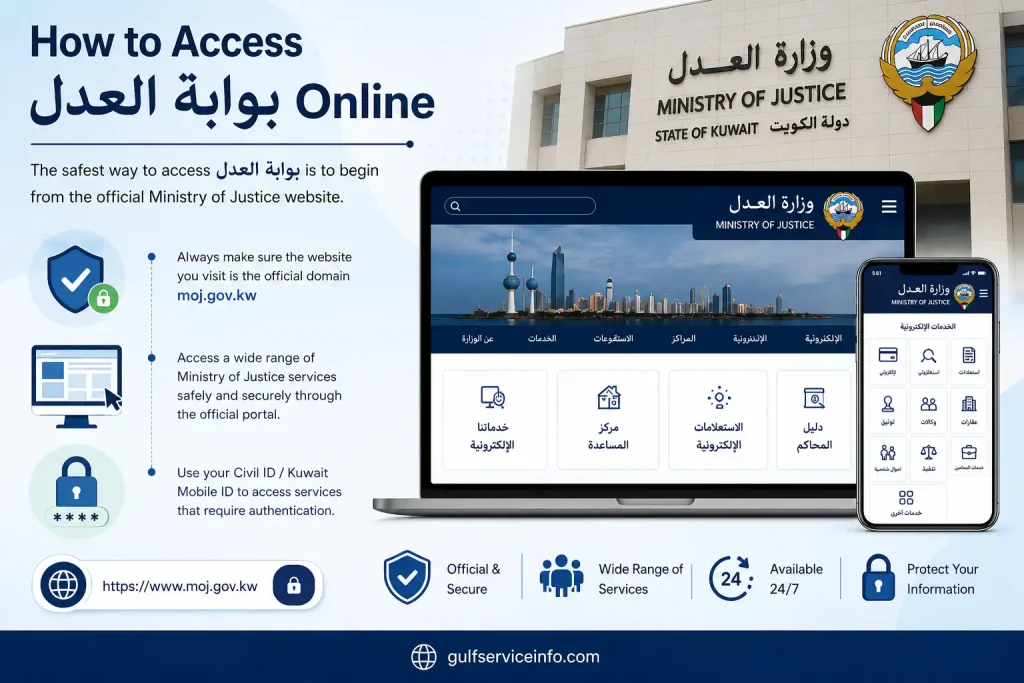
The safest way to access بوابة العدل is to begin from the official Ministry of Justice website.

Step 1: Open the official Ministry of Justice website

Open:

The website is the official online presence of Kuwait’s Ministry of Justice.

If you are searching Google or another search engine for terms such as بوابة العدل الكويت, Kuwait Justice Portal, or وزارة العدل الكويت, check that the result leads to the official moj.gov.kw domain before entering personal information.

Step 2: Find the electronic services section

Look for the Ministry’s Electronic Services area.

The official Ministry website identifies electronic services as one of its main service categories and provides access to services offered through the electronic portal.

For direct access to the Ministry’s current digital service platform, you can also use:

Kuwait Ministry of Justice – Electronic Services / Adl Platform

The current Adl Platform includes sections for electronic services, electronic payment, receipt enquiries, technical support and contact information.

Step 3: Select the service you need

Once inside the relevant service area, identify the category matching your transaction.

Depending on what you need, this may relate to:

  • Judicial enquiries
  • Electronic payment
  • Documentation
  • Authorisations and powers of attorney
  • Court-related services
  • Real-estate registration
  • Family services
  • Enforcement
  • Lawyers’ services
  • Other Ministry services
How to access بوابة العدل Kuwait online through the official Ministry of Justice website

Do not select a service simply because its name appears similar to your enquiry. Read the service description and check the required identification method before proceeding.

بوابة العدل (Kuwait Justice Portal) Services in 2026

The Ministry of Justice provides a broad range of services through its website and electronic platforms.

One useful feature of the official website is its Information Services Guide, which is intended to help visitors understand the procedural side of transactions and learn about the Ministry’s departments and sectors.

This makes the portal useful not only for completing transactions but also for finding out where a particular justice-related service belongs.

1. Judicial Enquiry Services

Judicial enquiries are among the most commonly associated services with the بوابة العدل.

The Ministry’s digital services have included judicial enquiry facilities for individuals, lawyers and companies.

Depending on the specific service, an enquiry may involve information related to court cases, proceedings or other judicial records.

Because access requirements can vary, users should follow the identification instructions shown by the official system rather than relying on instructions from third-party websites.

2. Electronic Payment

The Ministry also provides electronic payment facilities.

The current Adl electronic-services platform specifically lists electronic payment as one of its available sections.

For users who need to make an eligible payment through the Ministry’s digital system, the official platform is preferable to third-party payment websites.

3. Receipt Enquiry

The electronic platform also provides an option for enquiring about receipts.

This can be useful when a user needs to check information associated with a payment receipt rather than starting a new transaction.

4. Legal Documentation Services

The Ministry’s official website lists Legal Documentation Services as a distinct service area.

These services relate to documentation procedures handled through the Ministry’s relevant departments.

Users should check the individual service requirements because documentation procedures can differ according to the transaction.

5. Family Services and Counselling

The Ministry also lists Family Services and Family Counselling among its service areas.

This means that the بوابة العدل (Kuwait Justice Portal) is not limited to court-case enquiries. It also serves as a gateway to several wider justice and family-related government services.
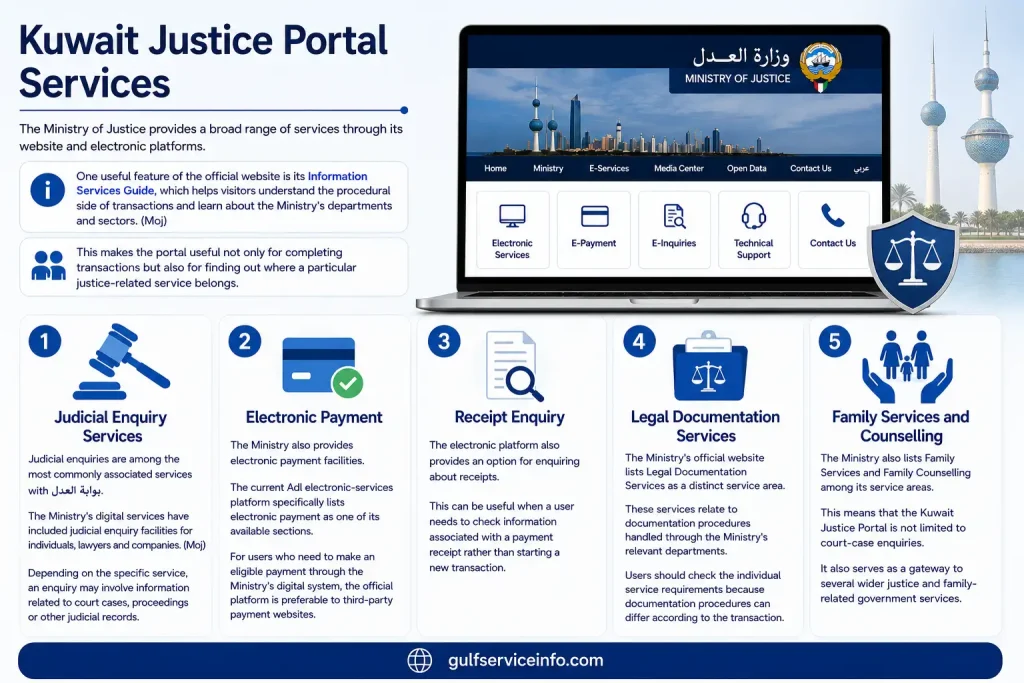
Kuwait Justice Portal services including judicial enquiry, electronic payment, receipt enquiry, legal documentation, and family services

What Can You Find on the Kuwait Ministry of Justice Website?

The official Kuwait Ministry of Justice website contains considerably more than the electronic transaction portal.

Visitors can find information relating to:

  • Ministry departments
  • Court clerks
  • Legal documentation
  • Family services
  • Enforcement and penalty registries
  • Judicial arbitration
  • Judicial fees
  • Real-estate registration
  • Experts
  • Lawyers
  • Recruitment
  • Government information-access requests
  • Legislation and laws
  • Judicial precedents
  • Ministry forms
  • Announcements and procurement information

The English version of the Ministry website also identifies court clerks, legal documentation, family services, enforcement and judicial arbitration and fees among its service areas.

This is particularly useful for foreign residents who may not know which Ministry department handles a particular transaction.

بوابة العدل Login: What You Need to Know

Some services require users to authenticate themselves before they can proceed.

The current Adl platform has a dedicated login page where users are asked for a user code, password and verification code.

You can access the official login system here:

Kuwait Justice / Adl Platform Login

Login process

  1. Open the official Ministry of Justice electronic-services platform.
  2. Select the login option where required.
  3. Enter your registered user code.
  4. Enter your password.
  5. Complete the displayed verification code.
  6. Select Login.
  7. After authentication, open the service you need.

If your service uses a different identity-verification method, follow the instructions displayed by that particular Ministry system.

Security tip: Never enter your civil ID, password or other authentication details into a website that does not belong to the official Kuwait government domain.

Kuwait Judicial Enquiry: How to Start

If your goal is to make a Kuwait judicial enquiry, start from the official Ministry of Justice website rather than searching for a separate unofficial portal.

The Ministry has dedicated electronic systems for judicial and justice-related enquiries. Its official materials also identify judicial enquiry services for individuals, lawyers and companies.

General process

1. Open the official Ministry website

Ministry of Justice Kuwait

2. Go to Electronic Services

Find the electronic-services section from the Ministry’s website.

3. Select the relevant judicial enquiry

Choose the enquiry that matches your situation.

4. Follow the identification instructions

The system may require an appropriate identification method before showing protected information.

5. Enter the requested information

Use accurate information exactly as requested by the official form.

6. Submit the enquiry

After submitting, allow the official system to process the request and display the information available to your account or enquiry type.

The exact fields and verification process can change between services, so users should rely on the instructions displayed on the official page at the time of use.

Important Things to Check Before Using بوابة العدل

Before beginning an online Ministry transaction, prepare the information requested by the particular service.

A useful preparation checklist is:

  • Use the official moj.gov.kw domain or an official Ministry subdomain.
  • Check the service description before starting.
  • Keep the required identification information available.
  • Use an active email address where the service requests one.
  • Make sure information entered into forms is accurate.
  • Read any confirmation or payment information before submitting.
  • Save transaction or receipt information when provided.
  • Avoid sharing passwords or authentication codes with anyone.

The Ministry’s privacy information also explains that personal information may be collected when users submit emails, electronic forms or data required for a particular electronic service.

Official Links for بوابة العدل (Kuwait Justice Portal) Users

For convenience, these are the main official links discussed in this section:

PurposeOfficial link
Ministry of Justice homepagemoj.gov.kw
Electronic Services / Adl PlatformAdl Electronic Services
Adl Platform LoginAdl Login
Electronic Power of Attorney / TawtheeqTawtheeq
Ministry English WebsiteMOJ Kuwait English Website

A useful distinction

بوابة العدل (Kuwait Justice Portal) is commonly used when referring to the Ministry’s online justice gateway, but the Ministry now operates several specialised digital systems. Therefore, if a particular service opens a separate moj.gov.kw or Ministry-operated platform, that does not necessarily mean you have left the official government service environment.

The key is to verify the domain and use links reached through the official Ministry website.

How to Register for Kuwait Justice Portal Services

Registration for بوابة العدل (Kuwait Justice Portal) services depends on the specific electronic service you want to use, because the Ministry of Justice operates several digital systems rather than one single registration process for every service. The official Ministry website directs users to different service categories, while some services use dedicated electronic platforms. In this section, you will learn how to approach registration, what information may be required, and how to avoid using an unofficial service.

Before You Register

Before starting a بوابة العدل registration or online transaction, identify the exact service first. This matters because a court enquiry, SMS notification service, electronic power of attorney, payment service and case-related service may follow different procedures.

It is useful to have the following information ready where applicable:

  • Civil ID or other required identification details
  • Mobile phone number
  • Email address, if requested
  • Existing Ministry user credentials
  • Case or transaction information, where applicable
  • Payment information for services that require fees
  • Access to the official identity-verification method required by the service

Do not assume that every service requires the same information. The official Ministry system displays the requirements for the selected service.

بوابة العدل (Kuwait Justice Portal) Registration Process

For most users, the safest registration route begins at the official Ministry of Justice Kuwait website rather than through a third-party registration page.

Step 1: Open the Ministry of Justice website

Visit the official website:

The Ministry’s website contains an Information Services Guide and a broad directory of Ministry procedures and electronic services. The official service directory includes courts, legal documentation, family services, implementation and penalty registries, judicial arbitration and fees, land registration and documentation, experts and other areas.
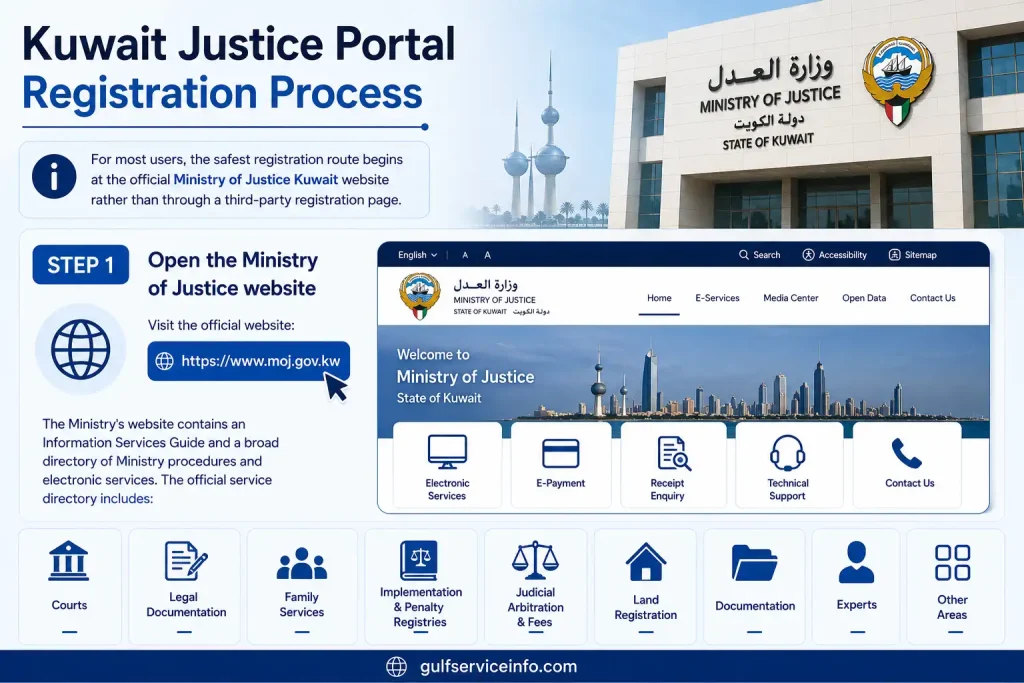
Open the official Kuwait Ministry of Justice website for Justice Portal services

Step 2: Select the relevant electronic service

Choose the service that matches your purpose instead of registering for an unrelated service.

For example, the official Ministry directory includes services such as:

  • Payment of fines
  • Travel ban enquiry
  • Enquiries on announcements
  • Enquiries on executive procedures
  • Judicial claim enquiry
  • Court-fee payment
  • Case-file services
  • Certificates
  • Electronic documentation services
  • Family-related services
  • Real-estate registration and documentation services

These are listed by the Ministry as part of its online service and procedure directory.
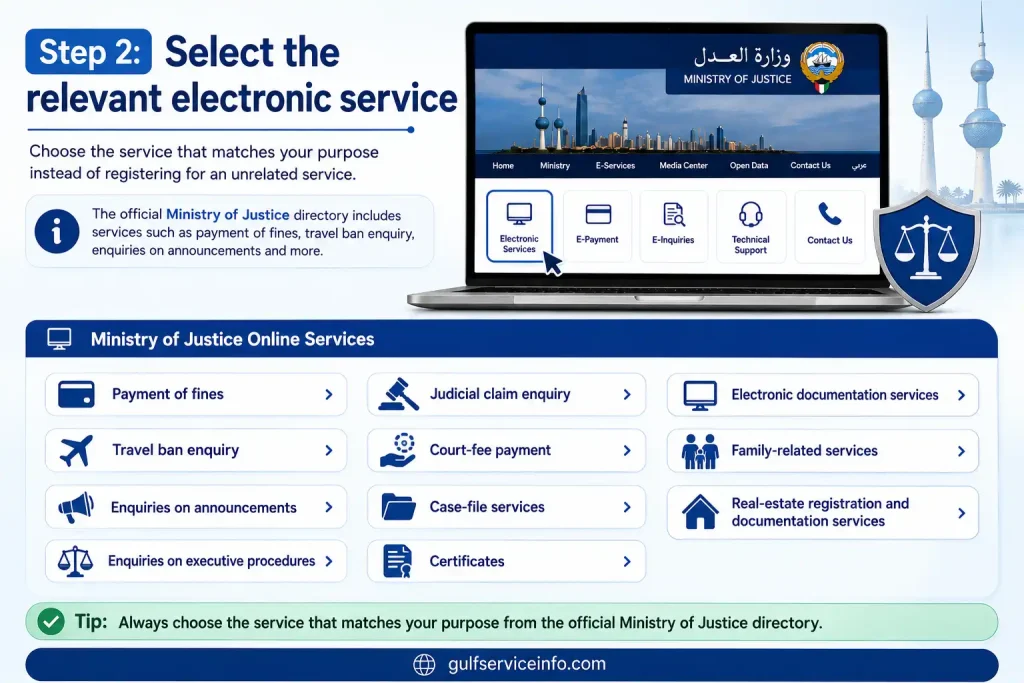
Select the relevant electronic service on the Kuwait Ministry of Justice portal

Step 3: Follow the registration instructions shown by the service

If the selected service requires an account, follow the registration instructions displayed on the official platform.

Some Ministry systems require a user code and password, while other services may use a different identity-verification process.

This is why it is better to follow the current instructions shown on the official بوابة العدل (Kuwait Justice Portal) service rather than using an old registration tutorial.
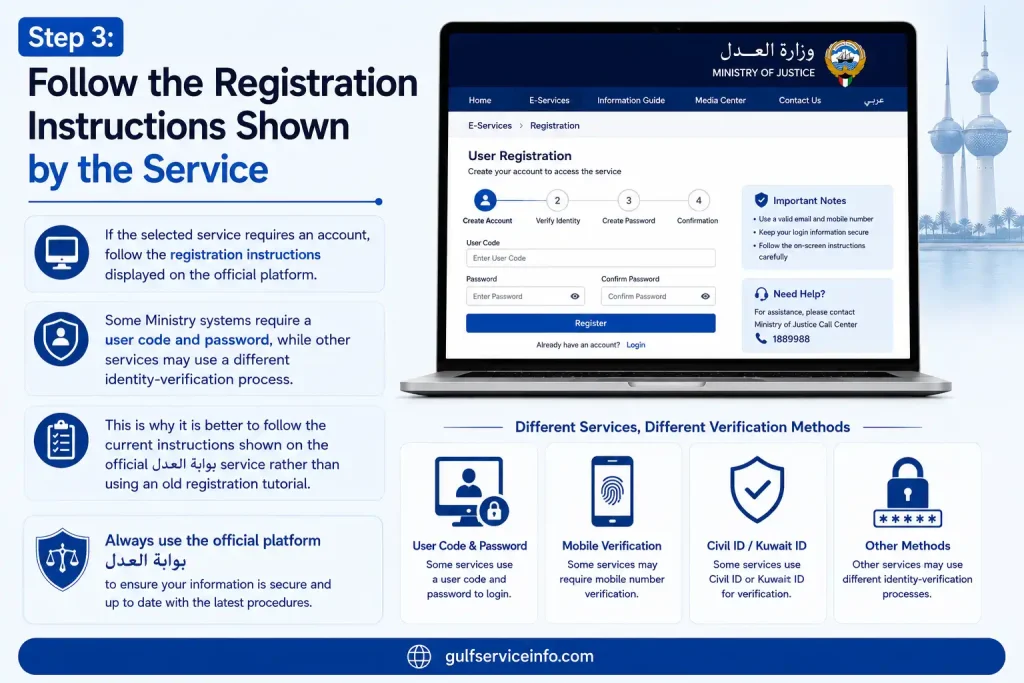
Follow the registration instructions shown by the service on the Kuwait Justice Portal

Step 4: Verify your identity

Where identity verification is required, enter the requested information carefully.

If the service sends an activation or verification code to your registered mobile number, use the code within the period specified by the system.
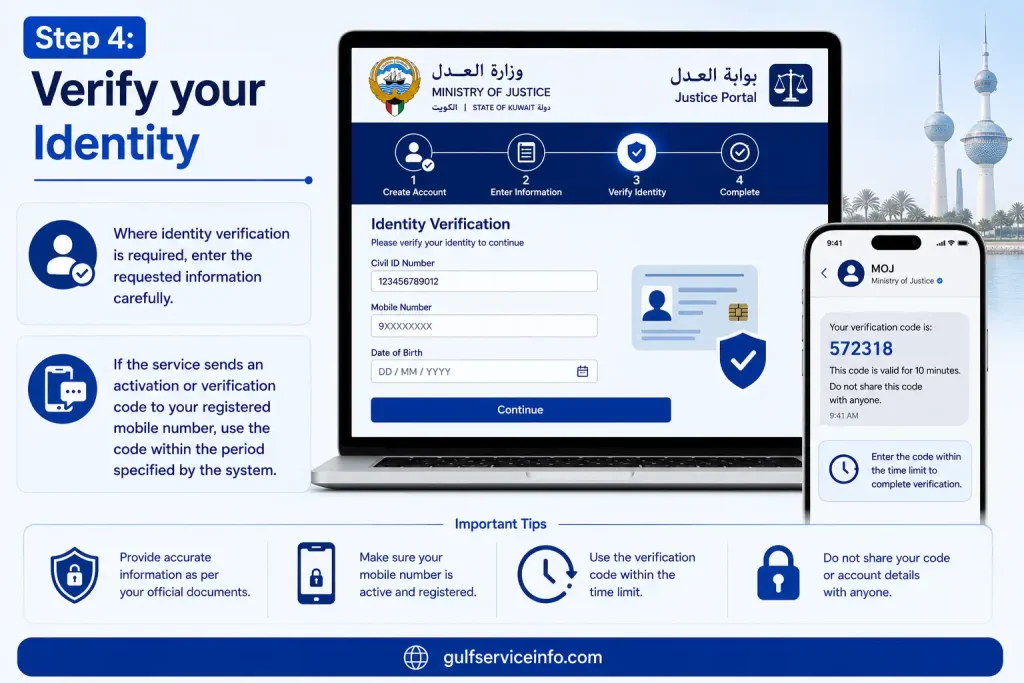
Verify your identity on the Kuwait Justice Portal using the required information and verification code

Step 5: Create or confirm your credentials

If the selected service asks you to create a password, choose a secure password that you do not reuse on unrelated websites.

Keep your login information private. Ministry credentials should not be shared with agents, social-media contacts or unofficial websites.
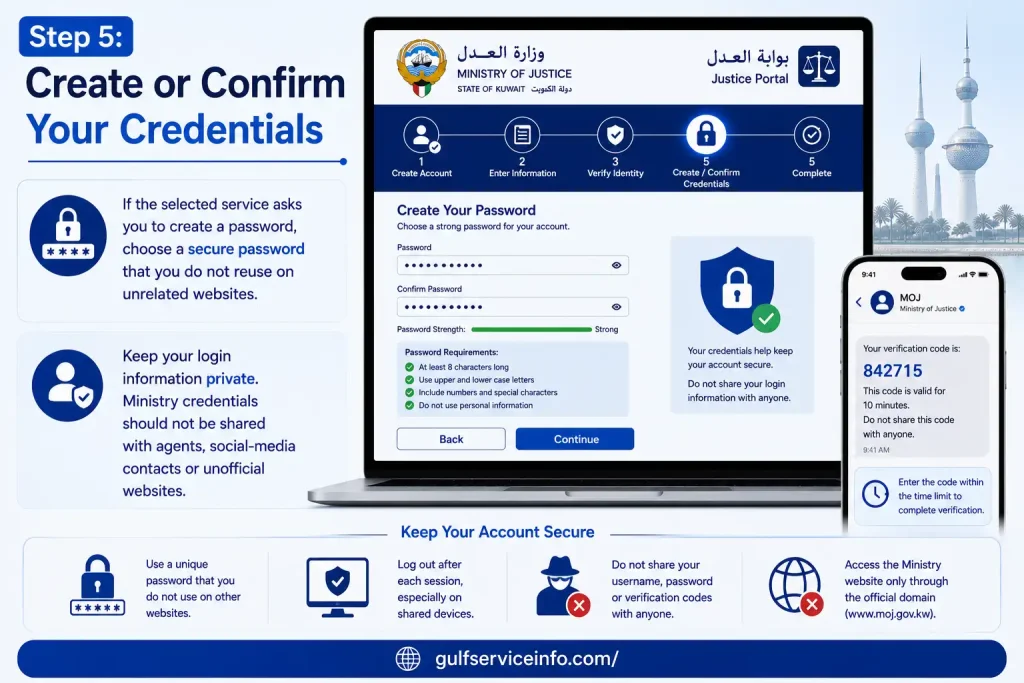
Create or confirm your credentials on the Kuwait Justice Portal

How to Check Judicial Information Through بوابة العدل

A major reason people search for بوابة العدل (Kuwait Justice Portal) is to check judicial information online. The Ministry’s official service directory includes several enquiry services, including judicial claim enquiries, announcement enquiries, executive-procedure enquiries and other case-related facilities.

The exact enquiry procedure depends on the type of information being requested.

Judicial Claim Enquiry

A judicial claim enquiry can help users access the relevant electronic service for checking information associated with a judicial claim.

To begin:

  1. Open the official Ministry of Justice website.
  2. Enter the electronic services area.
  3. Locate the judicial enquiry or judicial claim service.
  4. Read the identification requirements.
  5. Enter the requested information.
  6. Submit the enquiry.
  7. Review the information returned by the official system.

If the system does not display the information you expected, check that the details entered are correct and that you have selected the appropriate enquiry type.

Kuwait Fine Payment and Justice Portal Services

The Ministry of Justice’s official service directory includes Payment of fines and related services.

If you need to make an eligible payment through the Ministry, first confirm that the fine or payment is handled by the Ministry’s system.

General payment flow

  1. Open the official Ministry of Justice website.
  2. Locate the relevant electronic payment service.
  3. Enter the identification information requested.
  4. Search for the applicable payment or fine.
  5. Review the displayed information.
  6. Confirm the amount and transaction details.
  7. Continue to the official payment stage.
  8. Complete the payment using the supported method.
  9. Keep the receipt or confirmation information.

The Ministry’s electronic service directory also lists court fees payment, showing that payment-related services cover more than one type of transaction.

Tip: Always review the recipient, transaction type and amount before confirming an online payment.

Kuwait Case File and Court Services

The official Ministry directory contains a substantial group of services connected with court cases.

Examples include:

  • Case file services
  • Extracting printed copies of cases
  • Requests for copies of documents
  • Requests concerning hearing dates
  • Filing civil appeals
  • Criminal case registration
  • Appeals of municipal misdemeanour cases
  • Registration of attorney fees
  • Printing a provision
  • Appeal judgement handover
  • Requests for correcting factual errors
  • Requests to renew certain cases

The Ministry’s official service pages show these services under its court-related procedures.

The availability of an online option does not necessarily mean that every stage of a court procedure can be completed remotely. Some transactions may still require supporting documents, professional representation or action by the relevant court department.

Family Services Available Through Kuwait Justice Portal

The بوابة العدل (Kuwait Justice Portal) ecosystem also includes family-related services.

The Ministry’s official service directory lists services such as:

  • Custody certificate
  • Alimony certificate
  • Family counselling
  • Premarital counselling
  • Children and adolescents consultation
  • Family dispute settlement
  • Social and psychological counselling
  • Follow-up after reconciliation and divorce
  • Personal-status services
  • Family-related case procedures

These services demonstrate that the بوابة العدل (Kuwait Justice Portal) covers a wider range of justice matters than court-case enquiries alone.

For sensitive family matters, users should read the individual service requirements carefully because the procedure can depend on the type of request.

Legal Documentation and Power of Attorney Services

Legal documentation is another major area of the Kuwait Ministry of Justice.

The official service directory includes legal documentation services and related procedures.

For certain electronic power-of-attorney services, the Ministry operates a dedicated official system rather than requiring users to complete everything from the main Ministry homepage.

This is why users should distinguish between the main بوابة العدل (Kuwait Justice Portal) and specialised Ministry platforms.

Electronic Power of Attorney

The official Tawtheeq system is available here:

MOJ Kuwait Tawtheeq – Official Electronic Power of Attorney System

When a service opens a dedicated Ministry platform, check that the website is an official government domain before entering personal or legal information.

How to Find the Correct Ministry Service

With so many services available, the biggest challenge can be identifying the correct one.

A practical approach is:

Your needStart with
Check a judicial claimJudicial claim enquiry
Check announcementsAnnouncements enquiry
Check executive proceduresExecutive procedures enquiry
Check travel-ban informationTravel Ban Query
Pay an eligible finePayment of fines
Pay court-related feesCourt fees payment
Obtain a certificateRelevant certificate service
Handle family mattersFamily Services
Handle documentationLegal Documentation Services
Property registrationLand Registration and Documentation
Power of attorneyRelevant electronic documentation/Tawtheeq service
Court case documentsCourts Clerks / case services

The Ministry’s official directory is the best place to confirm the current service name and department.

Common Problems When Using بوابة العدل (Kuwait Justice Portal)

Even when a service is available online, users can encounter problems.

Login does not work

Check that you are using the correct official platform and the correct credentials. If the service uses a separate system, your credentials for another Ministry service may not automatically work there.

The requested information does not appear

First check the information entered into the enquiry form. Also make sure you selected the correct service and that the information you are requesting is available through that particular electronic service.

Verification code is not received

Check whether the registered mobile number is correct and able to receive SMS messages. Avoid repeatedly requesting codes if the system imposes a temporary limit.

Payment fails

Check the transaction details and payment method, then follow the instructions displayed by the official payment system. Keep any transaction reference or failed-payment information.

You cannot find a service

Use the Ministry’s Information Services Guide and service directory. The Ministry explicitly provides the guide to help users understand the procedural side of transactions and the responsibilities of its sectors and departments.

Frequently Asked Questions About بوابة العدل

If you’re concerned that a complaint, court case, travel ban, or other legal matter may have been registered against you in Kuwait, there are several official channels you can use to check your status. The most convenient options are the Sahel App, the Kuwait Government Online Portal, and relevant Ministry of Interior (MOI) or Ministry of Justice (MOJ) services.

Check Your Legal Status Online

Sahel App is one of the main digital options for checking government notifications and services. Sign in using your Civil ID and Kuwait Mobile ID, then review the relevant Ministry of Justice or legal-service sections for available information about complaints or cases.

You can also use the Kuwait Government Online Portal and access the MOI Personal Inquiry Service. Depending on the service available to your account, this can help you check information related to judgments, travel bans, immigration matters, and traffic-related status.

For court-related information, the Ministry of Justice portal provides services for checking registered cases and matters connected with the execution of judgements using your identification details.

If You Prefer to Check in Person

Online services may not always provide every detail about a complaint, particularly when the matter is very recent. If you believe a complaint may have been filed against you, you can visit a local police station or the relevant General Department of Investigation office and ask about the matter.

For a more formal court-status enquiry, you can also visit the Courts Complex (Palace of Justice) in Kuwait City. Take your original Civil ID with you and ask at the appropriate enquiry desk for assistance checking your legal status.

Tip: If the issue involves a possible travel ban or court judgement, checking the official government channels directly is preferable to relying on unofficial websites or third-party services.

If you need to check your criminal record in Kuwait or obtain an official Police Clearance Certificate (Criminal Status Certificate), you can request the document digitally through the Sahel app or the MOI Kuwait app. The certificate is issued electronically by the Ministry of Interior and includes a secure QR code for verification.

Request a Criminal Status Certificate Through Sahel

The Sahel app provides a convenient way to submit the request from your phone. Follow these steps:

  1. Open the Sahel app after installing it on your smartphone.
  2. Sign in using Kuwait Mobile ID or your Civil ID details.
  3. Open the Services section from the bottom menu.
  4. Select the Ministry of Interior.
  5. Look under Security Services for the Criminal Status Certificate service.
  6. Submit your request to issue the certificate.
  7. Once it is issued, view the certificate and download the digital document as a PDF.

Use the MOI Kuwait App Instead

You can also request the same certificate through the MOI Kuwait app. After installing the app, sign in with your available authentication method, such as your password, Face Lock, or Kuwait Mobile ID.

From the main dashboard, select Criminal Status Certificate, then choose Issue. Once the request is processed, you can view and download the official clearance document digitally.

Kuwait follows a civil-law framework that also incorporates principles of Islamic Sharia. Everyday activities such as employment, registered business, family matters, and normal private life are permitted within the limits set by Kuwaiti law and local regulations. At the same time, some activities that may be permitted elsewhere are strictly prohibited in Kuwait, particularly those involving alcohol, drugs, public expression, and certain personal conduct.

What Is Legal in Kuwait?

Several areas of everyday life are permitted when they are carried out in accordance with Kuwaiti regulations.

  • Business and commercial activities: Registered businesses can operate legally, employees can work under Kuwait Labour Law, and commercial activities are permitted when the required licences and approvals are obtained. Foreign investors may also establish certain types of branches or participate in public tenders subject to the applicable commercial rules.
  • Marriage, divorce and inheritance: Personal-status matters are handled under specific family-law frameworks. The applicable rules can differ according to a person’s religious background, including Sunni, Shia, and non-Muslim communities.
  • Normal private and public life: People with valid residency or visas can generally live and move within Kuwait according to the conditions of their status. Cultural and religious practices are also permitted within the boundaries established by Kuwaiti law.

What Is Illegal in Kuwait?

Visitors and residents should pay particular attention to activities that are strictly restricted under Kuwaiti law.

  • Alcohol and pork products: The possession, consumption, sale, or importation of alcohol is prohibited. Pork products are also subject to prohibition and strict restrictions. Driving under the influence or being publicly intoxicated can result in serious legal consequences.
  • Drugs and narcotics: Kuwait applies very strict drug laws. Possessing, using, or trafficking controlled substances can result in severe penalties, and even small or residual quantities may create serious legal problems. Drug-related or cannabis-themed clothing and items can also create legal concerns.
  • Speech and public expression: Certain forms of speech, including insulting or defaming Islam, the Emir of Kuwait, or foreign heads of state, can constitute criminal offences under relevant laws. Public gatherings may also require prior government approval, with the source material noting restrictions on gatherings of more than 20 people without a permit.
  • Sexual conduct and obscene materials: Sexual relations outside a legally recognised marriage are prohibited, and homosexual conduct is illegal under Kuwaiti law. Pornographic or obscene materials are also restricted, as are certain unauthorised religious-proselytising materials.
  • Prescription medicines: Some medicines, particularly certain psychotropic drugs and opioids, are tightly controlled. Travellers bringing such medication into Kuwait may need prior official authorisation and appropriate original medical documentation.

Important Note for Visitors and Residents

Kuwaiti law can differ significantly from the rules in other countries. Before travelling with medication, importing goods, making public statements, organising gatherings, or engaging in activities that may be legally sensitive, check the applicable Kuwaiti regulations and obtain any required permission or documentation.

The main email address for general enquiries to the Kuwait Ministry of Justice is [email protected]. The ministry also uses separate email addresses for certain departments, so contacting the relevant department directly may be more suitable for specific enquiries.

Ministry of Justice Email Contacts

Here are the email addresses provided for different types of enquiries:

Other Ways to Contact the Ministry

If email isn’t suitable, you can use the ministry’s other official contact channels:

  • Official website: Visit the Kuwait Ministry of Justice portal for online services and department information.
  • WhatsApp support: 00965 22486248 for enquiries related to electronic services.
  • Office address: Ministries Complex, Abdullah Al-Salem Street, Al-Mirqab, Kuwait City.

For a faster response, choose the contact method that matches your enquiry. General questions can be directed to [email protected], while department-specific matters may be better sent to the relevant departmental address.

The Kuwait Ministry of Justice generally operates during the morning from Sunday to Thursday, 7:30 AM to 2:00 PM. These hours apply to the ministry’s main administrative offices, courts complexes, and general government departments.

Some external service centres may also provide evening services from 4:00 PM to 8:30 PM, giving visitors an additional time window for selected transactions.

Regular Ministry and Court Hours

DayMorning Hours
Sunday7:30 AM – 2:00 PM
Monday7:30 AM – 2:00 PM
Tuesday7:30 AM – 2:00 PM
Wednesday7:30 AM – 2:00 PM
Thursday7:30 AM – 2:00 PM
FridayClosed
SaturdayClosed

These regular hours are stated for the main ministry complex, courts complexes, and general administrative offices.

Evening Service Centre Hours

Selected external transaction and citizen-service centres may operate an additional evening shift:

  • Days: Sunday to Thursday
  • Evening hours: 4:00 PM – 8:30 PM
  • Availability: Selected external service centres and certain governorate offices

Tip: Evening hours do not necessarily apply to every Ministry of Justice location. If you need to visit a specific service centre, check its individual schedule before travelling.

For a general police or criminal complaint, you will usually need to report the matter in person at a local police station. However, certain types of complaints—particularly cybercrime, electronic violations, and commercial or consumer issues—can be submitted through specialised government channels.

Online Reporting Options in Kuwait

The appropriate reporting method depends on the nature of your complaint:

  • Cybercrime and online harassment: Digital offences such as online harassment, hacking, or electronic extortion can be reported to the Electronic and Cyber Crime Combating Department. The provided information lists +965 97283939 as its dedicated contact number. You can also use the relevant section of the Ministry of Interior portal.
  • MOI electronic services: The Ministry of Interior E-Services platform can be used for certain electronic enquiries and social-service reports. Access to some services may require authentication through Kuwait Mobile ID.
  • Commercial or consumer complaints: If the issue involves a shop, company, commercial fraud, or another market-related matter, you can submit a complaint through the Ministry of Commerce and Industry’s online complaints service rather than using the general police reporting route.

Information You May Need

Before submitting a report, prepare the relevant details so the authorities can assess the complaint efficiently:

  • A valid Civil ID or Kuwait Mobile ID authentication
  • Your mobile number and email address
  • A clear description of what happened
  • The date, time, and location of the incident
  • Details of the other person or party involved, if known
  • Supporting evidence such as screenshots, photographs, documents, or other relevant files

Important: Not every type of police complaint can be completed entirely online. If your case concerns a general criminal offence, the available information indicates that you should normally contact or visit the appropriate police authority directly.

If you’ve been targeted by an online scam in Kuwait, report it through the appropriate authority as soon as possible. For electronic fraud, blackmail, and online scams, the Ministry of Interior (MOI) Cyber Crime Department is the main reporting channel. If you’re in immediate danger, call 112 for emergency assistance.

If you’ve already transferred money to a scammer, contact your bank immediately and ask whether the transaction or account can be blocked or otherwise secured.

Official Channels for Reporting Scams

The right authority depends on the type of scam or suspicious activity involved:

  • MOI Cyber Crime Department: Call +965 97283939 to report online scams, electronic fraud, or blackmail.
  • Central Bank of Kuwait (CBK): For suspected illegal financial activities or transactions involving unlicensed financial services, contact +965 22972999 or email [email protected].
  • Ministry of Commerce and Industry (MOCI): Consumer and commercial complaints can be submitted through the relevant MOCI channels. The provided information lists 135 for complaints.
  • CITRA: Suspicious websites, fraudulent phone numbers, and certain communications-related scams can be reported through the Communications and Information Technology Regulatory Authority (CITRA) reporting channels.

Evidence to Keep Before Reporting

Preserve as much evidence as possible. It can help authorities understand what happened and identify the person or account involved.

Keep:

  • Chat records, including WhatsApp conversations
  • The scammer’s phone number and social media username
  • Screenshots of suspicious websites, profiles, messages, or advertisements
  • Bank transfer receipts and transaction reference numbers
  • The date and time of suspicious calls, messages, or transactions
  • Any other documents or files connected with the incident

Act quickly: Don’t delete the conversations or payment records after discovering the scam. Save copies first, then report the incident through the appropriate official channel.

The highest punishment for cybercrime can be life imprisonment for exceptionally serious offences. Under the legal framework described in the source material, cyber terrorism is one such offence and can attract life imprisonment under Section 66F of India’s Information Technology Act.

The exact penalty depends on the nature of the cyber offence, the damage caused, and the specific provision of law that applies.

Cybercrime Penalties by Offence

Type of cybercrimeMaximum punishment mentioned
Cyber terrorism / national security threatLife imprisonment under Section 66F
Unauthorised access to protected critical systemsUp to 10 years’ imprisonment plus fines under Section 70
Online fraud, impersonation and identity theftUp to 3 years’ imprisonment and/or fines under Sections 66C and 66D
Unauthorised access and certain civil violationsCompensation and fines, including penalties of up to ₹1 crore for major disruptions or data-related violations under Section 43

Which Cybercrime Carries the Most Severe Penalty?

Among the offences listed above, cyber terrorism carries the highest punishment: life imprisonment. This reflects the seriousness of cyber offences that threaten national security or critical infrastructure.

For less severe offences, the punishment may involve shorter prison sentences, financial penalties, compensation, or a combination of these measures.

Important: The penalties above are based on the legal framework and sections cited in the provided source. Cybercrime laws vary by country, so the applicable punishment depends on where the offence occurred and which legislation applies.

Cybercrime is commonly grouped into four broad categories, depending on the main target of the offence: individuals, property, organisations, and society or government. Each category covers different forms of online attacks, fraud, harassment, and digital abuse.

1. Cybercrime Against Individuals

These offences target a specific person and often involve stealing personal information or using online platforms to harass or deceive someone.

  • Identity theft: Obtaining someone’s personal information and using it for fraudulent purposes.
  • Cyberstalking: Repeatedly harassing, monitoring, or threatening an individual through digital platforms.
  • Phishing: Using deceptive emails, messages, or websites to trick people into revealing passwords or other sensitive information.

2. Cybercrime Against Property

Property-related cybercrime targets digital assets, financial information, devices, or intellectual property.

  • Malware: Using harmful software, such as viruses, to damage or interfere with computers and other devices.
  • Card data theft: Stealing credit card, debit card, or banking information.
  • Intellectual property theft: Copying, distributing, or selling software, media, or other protected digital content without permission.

3. Cybercrime Against Organisations

These attacks are directed at businesses, institutions, or other organisations and can disrupt operations or expose confidential information.

  • Ransomware: Encrypting or locking an organisation’s files and demanding payment to restore access.
  • Denial-of-Service (DoS): Overwhelming a network or online service with traffic so that legitimate users cannot access it.
  • Data breaches: Gaining unauthorised access to confidential company, employee, or customer information.

4. Cybercrime Against Society or Government

These offences can have a wider impact by targeting governments, critical infrastructure, public institutions, or society as a whole.

  • Cyberterrorism: Using cyberattacks to disrupt critical infrastructure or create widespread fear.
  • Cyber espionage: Illegally obtaining confidential government, military, or other sensitive information.
  • Propaganda: Using online platforms to distribute illegal material or harmful false information.

Understanding these four categories makes it easier to identify the type of cybercrime involved and determine who or what is being targeted.

Artificial intelligence is increasingly being used by cybercriminals to make attacks faster, more targeted, and easier to scale. Criminals can use AI to automate parts of an attack, create convincing phishing messages, produce deepfakes, and analyse large amounts of information without needing the same level of technical expertise.

Key Ways AI Is Used in Cybercrime

  • Advanced social engineering: AI can produce highly convincing, personalised phishing emails and messages. Criminals may use publicly available information from social media and professional networks to make these scams appear more credible.
  • Voice and video deepfakes: AI can imitate a person’s voice or appearance, including during live video calls. Criminals may use these techniques to impersonate executives or other trusted individuals and persuade employees to approve fraudulent transactions.
  • Malware and exploit development: AI can assist criminals in generating, modifying, or disguising malicious code. The source material also notes the use of specialised, uncensored AI systems designed for illicit activities.
  • Exploiting AI-generated information: Criminals can take advantage of inaccurate information produced by AI assistants, such as non-existent websites, domains, or software packages. This can involve registering those names and using them to distribute malicious software to users or developers who assume they are legitimate.
  • Automated reconnaissance: AI can rapidly process large volumes of publicly available information and network data to identify potential weaknesses, map systems, and locate possible entry points.

The main advantage for cybercriminals is scale. Tasks that once required significant time or specialist knowledge can potentially be accelerated and automated with AI, allowing attackers to target more people and organisations in less time.

The FBI and EPA have warned that malicious cyber actors are targeting internet-facing Programmable Logic Controllers (PLCs) used by water and wastewater systems in several U.S. states. According to the warning, these attacks have caused operational disruptions at affected utility systems.

What Systems Are Being Targeted?

The reported attacks focus on industrial control equipment used to operate water and wastewater infrastructure, including:

  • Rockwell Automation/Allen-Bradley MicroLogix 1100 PLCs
  • Allen-Bradley 1400 series PLCs
  • Internet-facing operational technology connected to utility systems

The source material states that utility companies in at least seven states were affected, with more than 30 systems in Minnesota alone reportedly impacted.

How Did the Attacks Disrupt Operations?

According to the warning, attackers changed passwords on targeted devices. This prevented authorised human operators from accessing the control computers normally used to manage the systems.

As a result, some facilities had to switch to manual operations, temporarily affecting the normal functioning of water systems.

The available information did not indicate that drinking-water safety had been compromised, although some affected systems required local manual intervention to maintain operations.

How Can Water Utilities Protect Their Systems?

Operators can take several defensive measures to reduce the risk of similar attacks:

  • Remove compromised devices from the network: If unusual activity is detected, affected operational technology should be disconnected or taken offline where appropriate.
  • Replace default passwords: Use strong, unique passphrases instead of default, shared, or easily guessed credentials.
  • Protect operational networks: Internet-facing control equipment should be properly isolated and placed behind appropriate firewalls rather than being directly exposed to the public internet.
  • Report suspicious activity: Utility operators should monitor the FBI’s cyber-alert information and report suspected intrusions to the appropriate FBI field office or relevant authorities.

Key takeaway: The warning highlights the risk of exposing industrial control systems directly to the internet. Strong credentials, network isolation, and rapid incident reporting can help reduce the potential impact of attacks on critical water infrastructure.

Final Thoughts

The بوابة العدل (Kuwait Justice Portal) is the main digital gateway for accessing Kuwait Ministry of Justice information and a wide range of electronic justice services, including judicial enquiries, payment services, court procedures, legal documentation, family services, enforcement-related services and property-registration information. The most reliable approach is to start with the official Ministry of Justice Kuwait website and select the relevant electronic-service category, keeping in mind that some services operate through specialised official platforms. For sensitive transactions, always verify the official website, follow the current instructions, protect your login and verification details, and save any transaction confirmation or receipt after completing the service.
GulfServiceInfo Editorial Team

The GulfServiceInfo Editorial Team researches and publishes accurate, easy-to-follow guides on government, education, finance, immigration, employment, and public services across the UAE, Kuwait, and Qatar. Every article is fact-checked and references official government sources whenever possible to help readers access services confidently and efficiently.

Join WhatsApp

Join Now

Join Telegram

Join Now

Related Posts

Leave a Comment