Student Portal UAE: Login, IMS, LMS SSO & Smart Learning Guide

Published On: August 17, 2026
Follow Us
Student Portal UAE login, IMS, LMS SSO and smart learning guide

Finding the right UAE Ministry of Education student service can be confusing because students may encounter several connected systems, including the Student Portal, IMS, LMS, and SSO login pages. The important thing is to use the correct official MOE service for the task you want to complete. The Ministry’s SSO page currently provides email and password fields, a Remember Me option, and Forgot Password? functionality. It also describes the service as a trusted digital identity for citizens, residents and visitors. This Student Portal UAE guide covers the main login routes, IMS access, LMS and Smart Learning services, SSO authentication, common problems, frequently asked questions and the official links you should use.

Explore more UAE government services and helpful guides: Visit Our Homepage

Student Portal UAE Login

The Student Portal UAE is the main starting point for student-related Ministry services available through the official student system. You can access the portal directly from:

How to log in to Student Portal UAE

To begin your Student Portal UAE login, follow these steps:
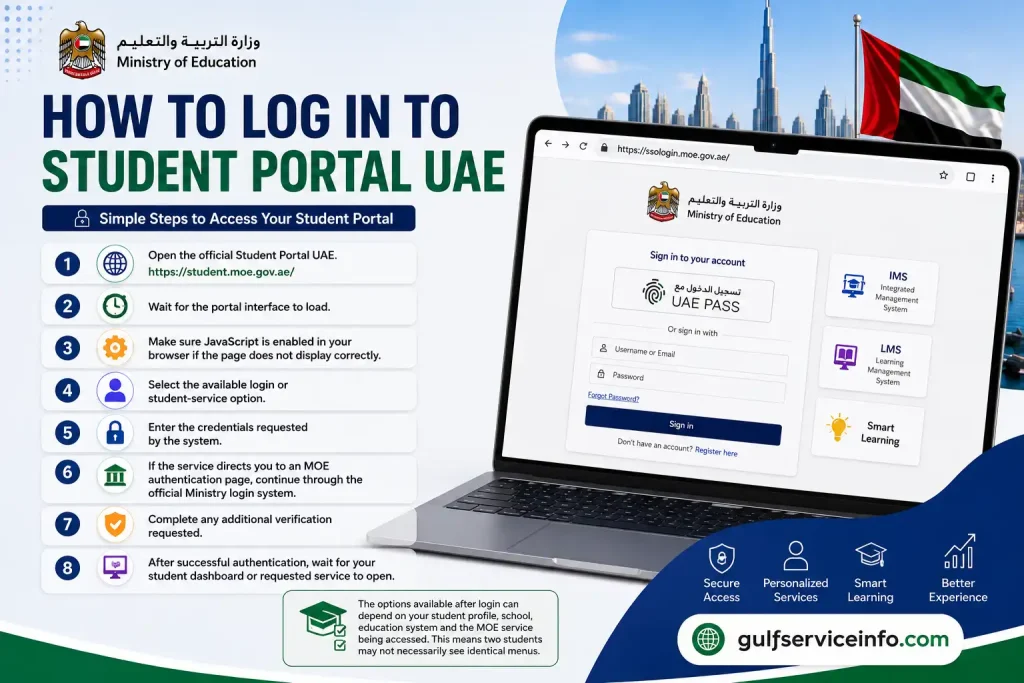
  • Open the official Student Portal UAE.
  • Wait for the portal interface to load.
  • Make sure JavaScript is enabled in your browser if the page does not display correctly.
  • Select the available login or student-service option.
  • Enter the credentials requested by the system.
  • If the service directs you to an MOE authentication page, continue through the official Ministry login system.
  • Complete any additional verification requested.
  • After successful authentication, wait for your student dashboard or requested service to open.
How to log in to Student Portal UAE step-by-step guide

The exact options available after login can depend on your student profile, school, education system and the MOE service being accessed. This means two students may not necessarily see identical menus.

Student Portal UAE login requirements

Before starting, keep the following ready:

  • Your registered student or MOE login details
  • Access to your registered email where required
  • A working internet connection
  • An updated web browser
  • JavaScript enabled
  • Your UAE PASS or other authentication method if the relevant service requests it
Student Portal UAE login requirements for students

Important: Always check that you are using an official moe.gov.ae domain before entering your login information.

IMS MOE Gov AE: Student Portal Access

Students searching for IMS MOE Gov AE are generally looking for a Ministry system connected with student information and education records. The terminology used by users can vary, so it is important not to assume that every IMS-related service is identical to the main Student Portal UAE.

The Ministry’s student information documentation describes authenticated access to student information through a dedicated information system. This can include information connected with a student’s academic profile.

How to access student information

If your account provides an academic or student-information section, the general process is:

  • Open the official Student Portal UAE.
  • Sign in with your authorised credentials.
  • Open the student dashboard.
  • Look for an option such as Student Information, Academic Records, or another relevant student-information service.
  • Select the required academic year or school period.
  • Review the information displayed.
  • Check your name and other identifying information.
  • Review subjects, grades, attendance or other information available to your profile.
  • Download or print the information if the service provides that option.

The information available through the Student Portal UAE can depend on what has been connected to your account.

Student information is missing

If you cannot find expected information after your Student Portal UAE login, check the following before assuming there is an account problem:

  • Did you select the correct academic year?
  • Are you using the correct student account?
  • Has your school completed the relevant data entry?
  • Is the information provided through another MOE service?
  • Does the school or Ministry need to update the record?

This distinction matters because the Student Portal UAE works alongside other Ministry systems rather than acting as the only location for every education service.

LMS SSO Login

LMS SSO login is another search term students may use when trying to reach Ministry learning services. SSO means Single Sign-On, which allows an authentication system to act as the entry point for connected services.

The official MOE SSO page is:

The current SSO page displays:

  • Email
  • Password
  • Remember Me
  • Forgot Password

It also identifies the service as a trusted digital identity for citizens, residents and visitors.

How to use LMS SSO login

If your learning service directs you to the MOE SSO system:

  • Step 1: Open the official SSO page.
    • Open MOE SSO Login
  • Step 2: Enter your registered email address.
  • Step 3: Enter your password.
  • Step 4: Select Remember Me only if you are using a trusted personal device.
  • Step 5: Select Login.
  • Step 6: If authentication succeeds, continue to the connected MOE learning service.

If you cannot remember your password, use the Forgot Password? option displayed directly on the official SSO page rather than entering your credentials into a third-party website.

How to use LMS SSO login through the UAE Ministry of Education

Security tip: Never give another person your SSO password or approve an authentication request that you did not initiate.

LMS MOE Gov AE and Smart Learning Gateway

The LMS MOE Gov AE service is associated with Ministry online learning systems rather than simply being another name for the Student Portal UAE. Students should therefore identify whether they need student records or learning materials before choosing a login page.

The supplied Ministry information notes that the MOE Smart Learning Gateway has its own login page, with email/password authentication and password-recovery functionality.

MOE Smart Learning Gateway Login

Student Portal UAE vs LMS

ServiceMain purpose
Student Portal UAEStudent-related Ministry services and information
IMS / student information servicesStudent and academic information
LMSOnline learning and educational resources
SSOAuthentication and access to connected Ministry services
Smart Learning GatewayOnline learning environment

The exact services available to an individual student can vary according to the account and Ministry system being used.

When should you use LMS instead of Student Portal UAE?

Use the Student Portal UAE when you are trying to access student-related Ministry information or services provided through the student system.

Use the relevant LMS when you are looking for online learning resources, courses, assignments or other learning materials hosted by the Ministry’s learning environment.

This difference can save time. If you repeatedly return to the Student Portal UAE looking for a learning resource that is hosted on the LMS, the resource may never appear in your student dashboard.

البوابة الذكية (Smart Learning Portal)

The البوابة الذكية, or Smart Learning Portal, is part of the UAE Ministry of Education’s wider digital learning environment. Students looking for the Smart Learning Portal should first identify whether they need access to learning resources or student records, because these services can be provided through different Ministry systems.

For online learning, the Ministry’s Smart Learning Gateway has a dedicated login environment. The available information indicates that this system uses email and password authentication and provides a password-recovery option.

Smart Learning Portal Login

If you need the Ministry’s learning environment rather than the standard Student Portal UAE, use the official LMS login:

The general access process is:

  • Open the official Smart Learning Gateway.
  • Enter the email address associated with your learning account.
  • Enter your password.
  • Select the login option.
  • Wait for the learning dashboard to load.
  • Open the course, subject or learning resource you need.
Smart Learning Portal login UAE through the Ministry of Education

The exact learning materials and options displayed after authentication depend on the account and services assigned to the student.

Smart Learning Portal or Student Portal UAE?

These names are sometimes used interchangeably in online searches, but they should not automatically be treated as the same system.

The Student Portal UAE is primarily an entry point for student-related Ministry services, while the Smart Learning Gateway is designed around online learning. If your goal is to access course resources, assignments or digital learning materials, the LMS may be the more relevant destination.

SSO Login for UAE Ministry of Education Services

The SSO login provides an authentication route for connected UAE Ministry of Education services. Instead of maintaining a separate login process for every service, an SSO environment can help authenticate a user before they continue to an authorised connected service.

The official MOE SSO website is:

MOE SSO Portal

The current SSO page includes fields for Email and Password, together with a Remember Me option and a Forgot Password? link.

How to complete an MOE SSO login

If a Ministry service sends you to the SSO page, use the following sequence:

1. Open the official SSO page

Go to sso.moe.gov.ae.

2. Enter your email

Use the email address registered with the relevant Ministry service.

3. Enter your password

Type the password associated with your SSO account.

4. Review the Remember Me option

Only use this option on a device you personally control and trust.

5. Select Login

Submit your credentials and allow the authentication process to finish.

6. Continue to the requested service

If the authentication is successful, proceed to the Ministry service you originally wanted to access.

Forgot your SSO password?

The official SSO page provides a Forgot Password? option. Use that route if you cannot remember your login details rather than repeatedly entering incorrect passwords.

If your account uses a different Ministry authentication method, follow the recovery instructions presented by the relevant official service.

Security warning: A legitimate SSO login should always be completed on an official Ministry domain. Avoid websites that ask you to enter your MOE email, password or other personal information while pretending to provide Student Portal UAE access.

Student Portal Services

The services visible after a Student Portal UAE login are not necessarily identical for every student. Your account profile, school, education system and the particular Ministry platform being accessed can affect what appears in the dashboard.

Possible student-related functions may include access to:

  • Student information
  • Academic records
  • Courses or subjects
  • Grades
  • Examination results
  • Learning resources
  • Other education services available to the student’s profile
Student Portal Services UAE including academic records, grades, courses and learning resources

The supplied Ministry information specifically notes that academic-record options can include Academic Records, Student Information, or similar menu items. Where available, students can select the relevant academic year and review subjects, grades, attendance or other academic information.

Checking academic information

After completing your Student Portal UAE login, look for the relevant student-information section. If an academic year selector is provided, choose the correct year before reviewing the record.

If something appears to be missing, check the selected year, account and school information first. A missing record can also mean that the relevant information has not yet been entered or that it belongs to another Ministry service.

Checking courses and subjects

Depending on your profile, you may see Courses, Subjects, Classes or a similar option. Select the academic year or term where required, then open the available course information.

If you are looking specifically for online learning resources, remember that the relevant information may be located in the LMS rather than the main Student Portal UAE.

Checking student results

Where results are released through the relevant Ministry service, students may find options such as Results, Grades or Examination Results.

A typical process is:

  • Open the official Student Portal UAE.
  • Sign in.
  • Open your student dashboard.
  • Select the results-related option.
  • Choose the academic year or examination period.
  • Review the displayed subjects and grades.
  • Download or print the result if the service provides that function.

Results may not appear if they have not yet been officially released, if the wrong academic period has been selected, or if the student record is not correctly connected to the account.

Student Portal, LMS & SSO Login Problems

Different login systems can produce different errors, so the first step is to identify which service you are actually trying to access: Student Portal UAE, LMS or SSO.

Student Portal UAE not loading

If the Student Portal UAE does not load correctly:

  • Check your internet connection.
  • Refresh the page.
  • Make sure JavaScript is enabled.
  • Use an updated browser.
  • Clear cache and cookies.
  • Try a private/incognito window.
  • Check that you are using the correct account.
  • Allow official MOE redirects or pop-ups if required.
  • Try again later if the Ministry system is temporarily unavailable.

The supplied portal information specifically identifies JavaScript and browser configuration as possible causes of access problems.

LMS login problem

If the LMS is not opening, first confirm that you are using the official Smart Learning Gateway rather than the general Student Portal UAE.

Official MOE Smart Learning Gateway

If you cannot remember the LMS password, use the recovery facility provided on the official LMS login page.

SSO login problem

For SSO problems, verify that:

  • Your email address is correct.
  • Your password is correct.
  • You are using the official MOE SSO domain.
  • Your browser is updated.
  • Cookies and cache are not causing a session problem.
  • You are not using an old saved login session.

Official MOE SSO

Academic information missing

If you can log in but your academic information is unavailable, check the academic year and student profile first. The school may also need to complete or update the relevant information.

Results not available

Results may simply not have been released yet. Before troubleshooting your account, confirm the relevant academic year and examination period.

Student Portal UAE FAQs

Yes, online schooling can be accepted in the UAE, but the school’s accreditation and recognition are key. Families should check whether the provider has recognised international accreditation or meets the relevant requirements of UAE education authorities, such as the Ministry of Education or KHDA.

What Makes an Online School Acceptable?

The fact that a school operates online does not automatically make its qualification recognised. Before enrolling, parents should look beyond the delivery method and confirm the status of the school and the qualification it awards.

Accreditation is especially important. Diplomas and transcripts from recognised international accrediting organisations, including bodies such as Cognia, WASC and NEASC, are more likely to support university admission and academic credit transfers.

Virtual and home education are also available as education options for families in the UAE.

Online School Options in the UAE

There are online providers serving students in the UAE under different recognition and accreditation arrangements. For example, iCademy Middle East operates within a regional recognition framework, while other virtual schools may rely on international accreditation from organisations outside the UAE.

Because recognition can vary between providers, parents should verify the specific school’s credentials rather than assuming that every online diploma has the same status.

What Should You Check Before Enrolling?

Before choosing an online school, review these points:

  • Accreditation: Check which recognised organisation accredits the school or programme.
  • University acceptance: Confirm that the resulting diploma meets the entry requirements of the universities your child may apply to.
  • Transfer records: Ask whether the school can provide official transcripts or transfer certificates if the student later moves to a traditional school.
  • Local recognition: Where relevant, check whether the qualification meets the requirements of the UAE education authority or the emirate where you live.

The safest approach is to verify the school’s accreditation and the qualification’s acceptance before paying fees or starting the programme. This can prevent problems later when applying to university or transferring to another school.

Accessing a student portal is usually straightforward. Start by visiting your school or university’s official website and locate the Student Portal, My Apps, or Campus Login option. You’ll normally need your assigned student ID or school email address and the password created during registration or your first account setup.

Student Portal Login Steps

  1. Open your school’s official website
    Look for a link labelled Student Portal, My Apps, Current Students, or Campus Login.
  2. Enter your student username
    Depending on your institution, this may be your student ID number or your official school email address.
  3. Enter your password
    Use the password you created during registration or when you first activated your student account.
  4. Select the Login button
    Click Login, Sign In, or the equivalent button to access your student dashboard.

What If You Cannot Log In?

Login problems are often caused by incorrect credentials, forgotten passwords, or a temporarily locked account.

  • Forgotten password: Select Forgot Password or Reset Password and follow the instructions to receive a password-reset link.
  • Incorrect login details: Recheck your student ID or email address and make sure Caps Lock is turned off before trying again.
  • Locked account: If repeated unsuccessful attempts have locked your account, contact your school’s IT department, service desk, or student support team for assistance.

Tip: Always use the official school website when accessing your student portal. Avoid entering your student credentials through unfamiliar login links.

Free education in the UAE is mainly available to UAE nationals and GCC citizens through public schools. For expatriates and international students, fully funded opportunities are more commonly found through competitive scholarships, selected government-supported programmes, and tuition-free specialist training.

The right option depends on your status, academic performance, and the type of education you want to pursue.

Free Education for K-12 Students

Public school education is generally tuition-free for UAE nationals, GCC citizens, and certain eligible passport holders.

Expatriate families may also have access to government schools in specific circumstances. For example, children of employees working for local government or semi-government organisations may be eligible if they meet the required academic criteria, including achieving at least 85% in core subjects. Standard public-school fees may still apply to most expatriate students.

Fully Funded University Opportunities

Higher education offers more options for students looking for education without tuition costs. The UAE Ministry of Education provides competitive scholarships for high-achieving students, with some programmes potentially covering tuition, living stipends, and airfare.

Several UAE universities also provide substantial funding to outstanding applicants. For instance, Khalifa University and Mohamed bin Zayed University of Artificial Intelligence (MBZUAI) offer fully funded opportunities that can include tuition coverage, monthly stipends, and accommodation for eligible students, particularly in STEM and AI-related programmes.

Private universities may also offer merit-based scholarships. Depending on the institution and the student’s academic record, these awards can range from partial discounts to full tuition waivers.

Tuition-Free Training and Online Learning

Students who are interested in skills rather than a traditional academic degree can consider specialised free programmes.

  • 42 Abu Dhabi: Offers tuition-free, peer-to-peer coding education.
  • TDRA Virtual Academy: Provides open-access online courses covering areas such as technology, artificial intelligence, and business, with free certificates available for eligible courses.

Which Option Is Right for You?

Student typePossible free education route
UAE nationalPublic K-12 schools and government-supported higher education opportunities
GCC citizenEligible public-school education and scholarship opportunities
Expatriate studentSelected government-school opportunities, scholarships and funded programmes
High-achieving university applicantGovernment or university-funded scholarships
Student interested in technologyTuition-free coding and digital training programmes

The key is to check the eligibility requirements before applying. Free education opportunities in the UAE are not available under one universal scheme; each school, university, scholarship, or training provider can have its own admission and funding conditions.

Online school fees in the UAE can vary significantly depending on the provider, curriculum, grade level, and amount of teacher support included. Based on the options described here, annual costs can range from around $2,000 (AED 7,300) for a basic self-paced virtual programme to more than $20,000 (AED 73,000+) for premium or blended learning arrangements.

A fully online programme is often less expensive than a traditional private school because families generally avoid costs associated with transport, uniforms, meals, and maintaining a physical campus.

Online School Fees by Type

The price you pay largely depends on how much structure and personal support the programme provides.

Online School TypeApproximate Annual CostWhat It May Include
Fully virtual international school$2,000–$10,000+ (AED 7,300–36,700+)Online curriculum, self-study or live classes
Boutique or specialised online academy$4,800–$19,000+ (AED 17,600–70,000+)More intensive teaching and smaller student-teacher ratios
Hybrid/blended learning hubAround $19,500 (AED 71,500)Physical facilities, mentors and structured supervision

Fully Virtual International Schools

Basic international online programmes can start at approximately $2,000 (AED 7,300) per year. These lower-cost packages may provide a self-paced curriculum based on British or US programmes.

More comprehensive virtual schools can cost around $5,500 to $10,000 annually, particularly when live lessons, teacher interaction, and additional academic support are included.

Hybrid Online School Options

Hybrid programmes sit between fully online education and traditional schooling. Students may study digitally while also having access to a physical learning hub, mentors, or supervised study sessions.

For example, the CambriLearn Hybrid Hub is listed at approximately $19,500 (AED 71,500) per year, reflecting the additional facilities and in-person support included in this type of programme.

Other Costs to Budget For

The advertised tuition fee isn’t always the total cost of online schooling. Check whether the following are charged separately:

  • External examination fees: Cambridge International or Pearson Edexcel examinations may require separate payment through an authorised examination centre.
  • Registration charges: Some providers may add an initial enrolment or administrative fee.
  • Technology or platform costs: Certain programmes may charge for setup, devices, or access to specific learning systems.
  • Other school-related expenses: Depending on the programme, optional tutoring, coaching, or additional academic services may cost extra.

Can Online School Save Money?

It can. Families may avoid several expenses associated with a physical school, including daily transport, uniforms, campus meals, and some facility-related costs. However, the overall saving depends on the online provider and whether the programme includes live teaching, examinations, mentoring, or access to physical facilities.

Before enrolling, compare the full annual cost, not just the advertised tuition. A cheaper package may have fewer teacher-led lessons or charge separately for examinations and other essential services.

A student portal is a secure online platform that brings many school or college services together in one place. Instead of using separate systems for grades, assignments, schedules, fees, and announcements, students can often manage these tasks through a single account.

Main Uses of a Student Portal

A student portal can support different parts of a learner’s academic and administrative experience.

  • Academic information: View class schedules, check grades and test results, and review feedback from teachers.
  • Coursework: Access lesson materials, watch recorded classes where available, and submit assignments online.
  • Student administration: Register for courses, review attendance, and update personal or contact information.
  • Fees and payments: Check tuition or fee statements, review available financial aid information, and make online payments when supported.
  • Communication: Read school announcements, check academic calendar events, and communicate with teachers or relevant staff.

In short, the student portal acts as a central access point for learning, administration, communication, and fee-related services, making it easier for students to manage their day-to-day school or college activities.

If you’re looking for an affordable private K–12 school in the UAE, Indian curriculum schools, particularly CBSE and Kerala-based schools, tend to have some of the lowest tuition fees. Based on the options listed here, annual fees can start from around AED 3,650 to AED 4,500 for younger students.

Some of the Lowest-Cost Schools

The following schools are among the budget-friendly options mentioned in the source:

SchoolCurriculumApprox. Starting Annual Fee
Little Flower English SchoolIndianAED 3,654
Crescent English High SchoolIndianAED 3,954
New Indian Model SchoolIndianAED 4,466
Arab Unity SchoolBritishAED 6,462

Little Flower English School

Little Flower English School is listed among the lowest-cost private school options, with fees starting at approximately AED 3,654 per year for kindergarten and primary-level students.

Crescent English High School

Crescent English High School offers an Indian curriculum across K–12. Its starting annual tuition is listed at around AED 3,954, making it another low-cost option for families.

New Indian Model School

For families considering another Indian curriculum option, New Indian Model School has early-year fees starting at approximately AED 4,466 per year.

Affordable British Curriculum Option

If you specifically want a British curriculum, Arab Unity School is listed as one of the more affordable choices. Its fees begin at around AED 6,462 annually, which is higher than the lowest-cost Indian curriculum schools but still comparatively budget-friendly.

What Determines School Fees in the UAE?

The cheapest option isn’t necessarily the same for every family. Several factors can change the final cost:

  • Curriculum: Indian CBSE and Kerala curricula generally have some of the lowest starting fees, followed by budget Pakistani and British curriculum schools.
  • Grade level: Tuition often increases as students move into higher grades, particularly Grades 9–12, where examination-related costs can add to the overall expense.
  • Emirate: Dubai and Abu Dhabi have extensive school fee listings and regulations, while Sharjah, Ajman, Ras Al Khaimah and other Northern Emirates may offer additional lower-cost community school options.

Before choosing a school based solely on tuition, compare the total annual cost, including registration, transport, uniforms, books, examination charges and other compulsory fees.

Yes. Under Federal Decree Law No. 39 of 2022 on Compulsory Education and Wadeema’s Law (Child Rights Law), parents or legal guardians are responsible for enrolling their children in school and ensuring they attend regularly throughout the period of compulsory education.

The exact education requirement differs between UAE citizens and expatriate residents, so families should understand which rules apply to them.

What Are the UAE School Attendance Requirements?

The compulsory education rules outlined in the source can be summarised as follows:

  • UAE citizens: Education is compulsory from the primary stage through the completion of secondary education.
  • Expatriate residents: Compulsory education applies through the primary school stage.
  • Valid exemptions: A child may be excused from school enrolment or attendance in specific circumstances, such as a serious illness or a documented disability.

Parents should not assume that simply choosing not to send a child to school is permitted. Where an exemption applies, the relevant reason generally needs to be properly documented.

What Happens If a Child Does Not Attend School?

Authorities can take action when a child is not enrolled or has excessive unexplained absences. The process may begin with a written warning from the Ministry of Education or the relevant local authority, giving the parent or guardian an opportunity to resolve the issue.

If the situation is not corrected, parents may face more serious legal consequences.

Can Parents Be Fined or Imprisoned?

According to the source information, failure to comply with compulsory education requirements can result in fines ranging from AED 2,000 to AED 50,000 and/or imprisonment.

This means parents should take school enrolment and attendance obligations seriously, particularly when a child is repeatedly absent without an accepted reason.

How Many Unexcused Absences Are Allowed?

The stated attendance limits allow students a maximum of 5 unexcused absences per term or 15 during the academic year.

There are also stricter rules around absences immediately before weekends or holidays. In certain circumstances, such an absence can be counted as a double absence. Exceeding the permitted attendance limit may also result in the student being required to repeat the academic year.

Important: Attendance rules and enforcement can depend on the applicable education authority and the student’s circumstances. Parents should check the current requirements with the relevant UAE education authority if they are dealing with prolonged absence or an exemption.

To access your student portal, start with your school or university’s official website and locate its student login page. You’ll generally need the student ID, student number, or school email address assigned to you, along with your password.

Steps to Access Your Student Portal

  1. Open the official portal page
    Visit your school’s official website and look for Student Portal, Login, or Current Students.
  2. Enter your student ID
    Type the student number, student ID, or school email address provided by your institution.
  3. Enter your password
    Enter your account password. For newly admitted students, the institution may initially provide a temporary code or default password, such as a PIN or other details included in your admission instructions.
  4. Select Login
    Click Login, Submit, or the relevant sign-in button to open your student dashboard.

What If You Cannot Access Your Account?

If your credentials aren’t working, try the following options:

  • Forgot your password: Use the Forgot Password or password-reset option available on the login page.
  • New student: Check the personal email address you provided during admission for your student number, activation instructions, or initial login details.
  • Account or technical problem: Contact your school’s IT support or help desk if your account is locked or your credentials continue to fail.

Tip: Always access the portal through your institution’s official website rather than relying on unfamiliar login links.

According to the source information, students are not allowed to bring or use mobile phones on school premises in UAE public and private schools under Ministry of Education guidelines. A phone brought to campus can be confiscated as a violation of student behaviour rules.

What Happens If a Student Brings a Phone?

The stated confiscation measures depend on whether the student has broken the rule before:

  • First offence: The school may keep the phone for one month.
  • Repeat offences: The device may be withheld until the end of the academic year.

These measures are intended to discourage students from bringing unauthorised mobile phones onto school premises.

How Are School Rules Enforced?

Schools may carry out checks of students’ bags and personal belongings to identify prohibited items. According to the provided information, these inspections should be conducted respectfully, and staff members are not permitted to physically touch students while carrying out checks.

Are Tablets and Laptops Allowed?

Educational devices such as tablets and laptops, including ministry-issued devices, can be permitted when they are being used for approved learning activities.

However, the source states that using these devices during breaks or outside authorised lesson times may also be treated as a student behaviour violation.

Key point: A tablet or laptop used for an approved school activity is different from a personal mobile phone. Students should follow their school’s specific device policy to avoid disciplinary action.

Many teaching positions in Dubai include some form of housing support, but free accommodation is not guaranteed with every teaching job. Depending on the school and employment package, teachers may receive school-provided accommodation, a separate housing allowance, or no housing benefit at all.

What Housing Benefits Can Teachers Receive?

Schools generally handle accommodation in one of several ways:

  • School-provided accommodation: Some international schools provide teachers with apartments that may be furnished and equipped with basic appliances. The accommodation may be provided at no additional cost to the teacher.
  • Housing allowance: Instead of providing a property, many schools offer a fixed housing allowance that is added to the teacher’s salary. The teacher then arranges and pays for their own accommodation.
  • No housing benefit: Some smaller, lower-paying, or local schools may offer an all-inclusive salary without a separate accommodation package.

What Should You Check in Your Employment Contract?

A housing package can look attractive at first, but the details matter. Before accepting a teaching position, check exactly what the school covers.

Utilities: School-provided accommodation may not include electricity, water, internet, or other household bills.

Family status: Some accommodation packages are designed for single teachers. Housing allowances may also differ depending on whether you have dependants.

Location: Employer-provided accommodation may be conveniently located near the school, but this isn’t always the case. Check the actual location and expected commuting time before accepting the package.

The best way to know whether a Dubai teaching position includes free housing is to review the full employment contract and benefits package, rather than relying only on the advertised salary.

A typical school day in Dubai lasts around 6 to 7 hours, although the exact timetable varies by school and age group. For many students, classes begin at about 7:30 AM and finish between 2:00 PM and 3:00 PM from Monday to Thursday.

Fridays follow a shorter schedule, with schools finishing by around 11:30 AM under the stated KHDA arrangements.

What Does a Typical School Week Look Like?

The weekly timetable generally follows this pattern:

  • Monday to Thursday: Full school days, usually lasting about seven hours. A common example is 7:30 AM to 2:30 PM, although individual schools may use different timings.
  • Friday: A shortened school day, with students dismissed by 11:30 AM.
  • Saturday and Sunday: Regular school holidays or rest days.

Do School Hours Change by Age?

Yes. Younger children generally spend fewer hours at school than older students.

Kindergarten and Foundation Stage: Early-years pupils may attend from around 8:00 AM until 12:00 PM or 1:00 PM on regular days, with Friday schedules ending earlier.

Primary and Secondary Students: Older students generally follow longer timetables, often from approximately 7:30 AM to 2:30 PM or 3:00 PM. Some schools may also offer enrichment or other activities beyond the core school day.

Keep in mind: School timings can differ between institutions and grade levels, so parents should check their child’s school’s official timetable for the exact start and finishing times.

Dubai can be an attractive study destination, but it also has several challenges that international students should consider before enrolling. The biggest concerns include high tuition and living expenses, limited formal part-time work options, extreme summer temperatures, and a competitive graduate job market.

Financial Challenges for International Students

The cost of studying and living in Dubai can be a major drawback, particularly for students who need to manage their expenses without regular employment.

  • Limited part-time work options: International students do not generally receive the same broad off-campus part-time work rights associated with study destinations such as Canada, the UK, or Australia.
  • High living expenses: Accommodation, food, utilities and transportation can be expensive, particularly in popular areas close to universities.
  • Additional daily costs: Regular taxi use, commuting and obtaining a UAE driving licence can add considerably to a student’s budget.

Academic and Career Considerations

The quality and career value of studying in Dubai can vary considerably between institutions.

A relatively young higher-education sector: Some branch campuses and private universities in Dubai have shorter histories and may not offer the same depth of research activity or long-established reputation as major Western universities.

A competitive graduate job market: Finding a suitable position after graduation can be challenging. Local networking and professional connections may play an important role when employers are choosing between fresh graduates.

No automatic permanent residency: A student residence visa is temporary and normally requires renewal. Completing a degree does not automatically provide a direct route to permanent residency.

Lifestyle and Climate Challenges

Dubai’s environment can also take some adjustment for international students.

Very hot summers: Temperatures can rise above 45°C (113°F) during the hottest periods, which can make outdoor activities uncomfortable or impractical for extended periods.

Local laws and cultural expectations: Students are expected to respect UAE laws and local cultural norms, including rules concerning public behaviour, dress and conduct.

Is Studying in Dubai Worth It?

That depends on your priorities and budget. Dubai can offer an international environment and access to universities and branch campuses, but students should weigh these advantages against tuition costs, living expenses, work limitations, climate and post-graduation employment prospects.

Some graduates and students online have also expressed concerns about whether the financial investment provides enough career benefit compared with studying in North America or Europe. These experiences are personal and can vary significantly by university, degree and career field.

Based on the information provided, three of Dubai’s leading schools are Dubai College, Repton School Dubai, and Kings’ School Dubai. All three are described as having an “Outstanding” KHDA inspection rating, along with strong academic reputations.

Dubai College

  • Curriculum: British National Curriculum for England
  • Age range: 11–18 years
  • Location: Al Sufouh
  • Why it stands out: Dubai College is known for selective admissions and excellent GCSE and A-Level results, with academic performance comparable to leading UK private schools.

Repton School Dubai

  • Curriculum: British / IB
  • Age range: 3–18 years
  • Location: Nad Al Sheba
  • Why it stands out: The school has a large modern campus and combines academic education with strong sporting programmes. It is also associated with its established UK sister school.

Kings’ School Dubai

  • Curriculum: British
  • Age range: 3–11 years
  • Location: Umm Suqeim
  • Why it stands out: Kings’ School Dubai is particularly recognised for its primary education and is described as having maintained an “Outstanding” KHDA rating since inspections began in Dubai.

Quick Comparison

SchoolCurriculumAgesLocationMain Strength
Dubai CollegeBritish11–18Al SufouhGCSE & A-Level performance
Repton School DubaiBritish / IB3–18Nad Al ShebaAcademics, sport & campus
Kings’ School DubaiBritish3–11Umm SuqeimPrimary education

The best choice depends on the student’s age, preferred curriculum, location and academic goals. While all three have strong reputations, their age ranges and educational offerings are quite different.

A 15-year-old in Dubai will usually be in Grade 10 under the American or International Baccalaureate (IB) systems, while students following the British curriculum are generally in Year 11. Placement can vary because Dubai schools follow different international education systems.

Grade Placement by Curriculum

CurriculumTypical Grade for a 15-Year-Old
AmericanGrade 10
International Baccalaureate (IB)Grade 10
BritishYear 11
Indian (CBSE)Grade 9 or Grade 10

Why Can the Grade Differ?

Age alone does not always determine a student’s school year in Dubai. The curriculum, birth month and academic-year starting date can affect placement, particularly in schools following the Indian CBSE system.

For example, a 15-year-old studying under the British curriculum would typically be in Year 11, which is commonly the year associated with preparation for IGCSE examinations. Under the American or IB systems, the same age would generally correspond to Grade 10.

For CBSE schools, the student may be placed in Grade 9 or Grade 10, depending on their birth date and the school’s academic-year structure.

Final Thoughts

The Student Portal UAE provides a central starting point for accessing important UAE Ministry of Education services, while IMS, LMS, Smart Learning and SSO support different parts of the digital education system. For the safest experience, always use the official Student Portal UAE and MOE SSO links, check that you are on the correct Ministry website, and use the appropriate login system for the service you need. Whether you are checking student information, accessing learning resources, reviewing academic results or recovering your account, following the official MOE login route can help you avoid unnecessary access problems and keep your account information secure.

GulfServiceInfo Editorial Team

The GulfServiceInfo Editorial Team researches and publishes accurate, easy-to-follow guides on government, education, finance, immigration, employment, and public services across the UAE, Kuwait, and Qatar. Every article is fact-checked and references official government sources whenever possible to help readers access services confidently and efficiently.

Join WhatsApp

Join Now

Join Telegram

Join Now

Leave a Comment