Achieve3000 Login: Portal, Clever Access & Complete Guide

Published On: August 25, 2026
Follow Us
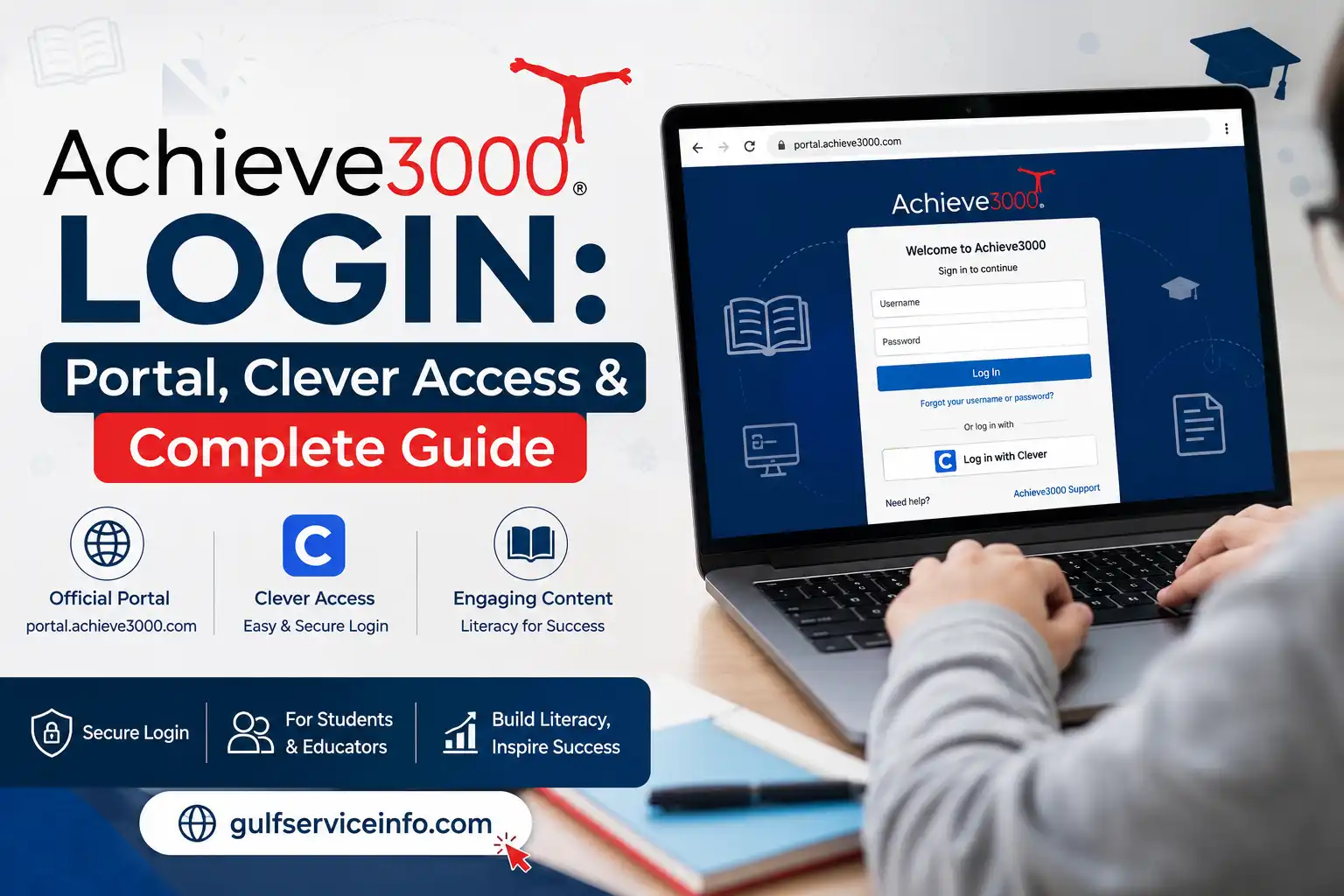
Achieve3000 Login portal with Clever access and online learning guide

If you need to reach your Achieve3000 account, the main starting point is the official Achieve3000 portal. Students, teachers, and other authorised users can use the platform to access lessons, reading activities, progress information, and other learning tools. Achieve3000 Literacy is designed around differentiated content and instruction, with reading material adjusted to different learner levels.

This Achieve3000 login guide covers the portal, Clever access, student and teacher sign-in, lessons, password issues, common login problems, and where to get official support.

Explore more student portals and helpful education guides: Visit Our Homepage

What Is Achieve3000?

Achieve3000 is a digital learning platform focused on differentiated instruction and literacy development. Its literacy solution provides content at different reading levels so students can work with material suited to their current skills while continuing to develop comprehension and related abilities.

The platform uses tools such as LevelSet assessment, differentiated reading content, embedded assessments, vocabulary support, and progress dashboards. According to Achieve3000’s official materials, its literacy platform serves grades 2–12 and provides content differentiated across 12 English levels and eight Spanish levels.

For many users, the first step is simply finding the correct Achieve3000 login page. If your school or district has provided direct credentials, use those details rather than creating a separate account.

Achieve3000 Login

The official Achieve3000 login portal is:

To sign in, open the official portal and use the account information supplied by your school, district, or organisation.
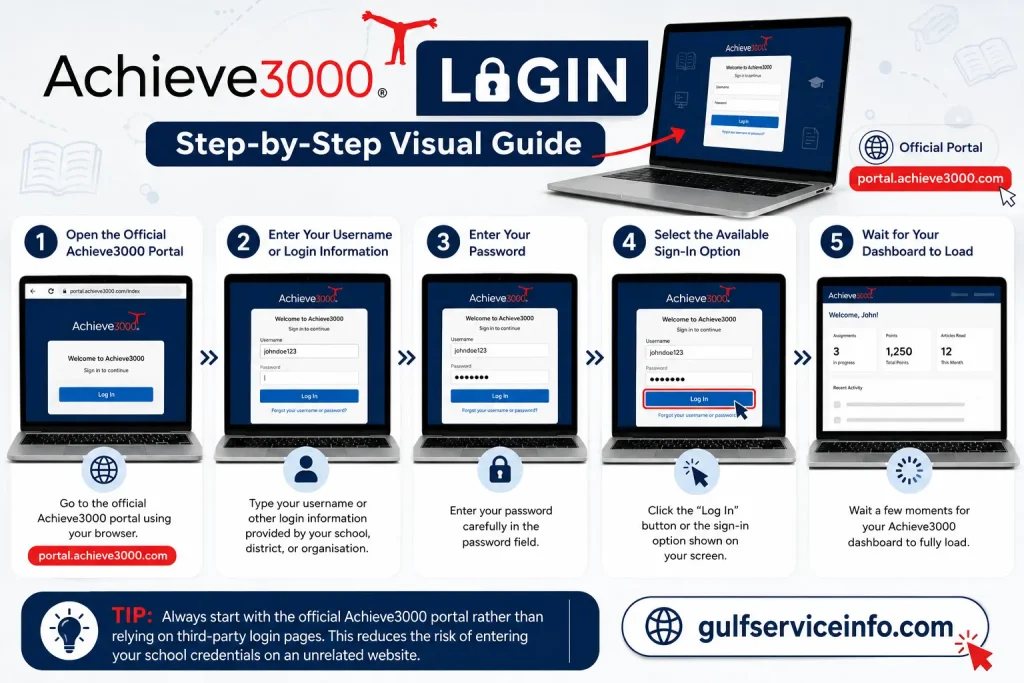
  • Open the Achieve3000 official portal.
  • Enter the username or other login information requested on the sign-in page.
  • Enter your password.
  • Select the available sign-in option.
  • Wait for your Achieve3000 dashboard to load.
Achieve3000 Login portal with step-by-step sign-in instructions

Your exact login screen can depend on how your school has configured access. Some organisations use direct credentials, while others connect Achieve3000 with a single sign-on system.

Tip: Always start with the official Achieve3000 portal rather than relying on third-party login pages. This reduces the risk of entering your school credentials on an unrelated website.

How to Access the Achieve3000 Portal

The Achieve3000 portal is the central place to begin when you want to use the platform. After a successful login, the available features depend on whether your account is set up as a student, teacher, family, or another authorised user.

A typical access process looks like this:

Official portal → Sign in → Account dashboard → Lessons and activities

If your school has given you a specific login method, follow those instructions first. School-managed accounts may be connected to systems such as Clever, Google Classroom, Canvas, Schoology, or other rostering and single sign-on arrangements. Achieve3000’s current support resources list Clever, Google Classroom, OneRoster, Canvas, and Schoology among its rostering or integration options.

If the portal does not open correctly, try a current browser and make sure your internet connection is stable. If the page appears outdated or behaves strangely, browser caching can sometimes affect web applications; Achieve3000’s support documentation recommends clearing browser cache when cached information causes inconsistencies.

Achieve3000 Login With Clever

Students whose schools use Clever may be able to reach Achieve3000 through their school’s Clever environment instead of entering Achieve3000 credentials manually. Achieve3000’s official rostering resources specifically include Clever as an integration option.

How to Use Clever for Achieve3000

  • Open your school’s Clever login page.
  • Sign in using the method provided by your school.
  • Open your Clever student or teacher portal.
  • Look for the Achieve3000 application.
  • Select Achieve3000.
  • Allow the system to redirect you to your learning environment.
Achieve3000 Login With Clever showing the steps to access

The exact Clever screen can vary because schools control their Clever setup and available applications. If Achieve3000 is missing from your Clever dashboard, contacting your school’s teacher, technology coordinator, or administrator is usually more useful than repeatedly attempting the direct Achieve3000 login.

Achieve3000 Student Login

The Achieve3000 student login gives learners access to their assigned lessons and other activities available through their school’s account. Once inside the Student Edition, students can review lesson progress and identify work that still needs to be completed.

Achieve3000’s support documentation explains that students can open My Lessons from the dashboard and review lessons in progress. Completed lesson steps are shown differently from unfinished steps, making it easier to identify missing work.

Student Access Checklist

Before trying to sign in, have these details ready:

  • Your school-issued username or login method
  • Your password, if your school uses direct credentials
  • Access to your school’s Clever account, if required
  • A supported, up-to-date browser
  • A reliable internet connection

If your school uses Clever, start there rather than trying to bypass the school’s sign-in process.

Achieve3000 Student Login dashboard showing My Lessons and student progress

Achieve3000 Teacher Login

Teachers use Achieve3000 to access instructional resources and monitor student activity and progress. The platform includes a teacher dashboard designed to help educators track student performance and growth.

The Achieve3000 teacher login process is generally similar to student access, but the account permissions and dashboard will be different.

If your school uses single sign-on, your administrator may expect teachers to enter through Clever or another connected platform. Achieve3000’s official support centre includes resources for Clever, OneRoster, Google Classroom, Canvas, and Schoology integrations.

If you cannot see your classes or students after signing in, the problem may be related to your school’s rostering setup rather than your password. In that situation, contact the person responsible for your school’s Achieve3000 or student-information-system setup.

How to Use the Achieve3000 Portal

After a successful Achieve3000 login, the dashboard becomes the main starting point for your learning or teaching activities. The exact options depend on your account type, but students can use the platform to work through assigned lessons while teachers can access classroom and progress information.

For students, one of the most useful areas is My Lessons. Achieve3000 support documentation explains that students can review lessons in progress from the dashboard and see which parts of a lesson have been completed. This makes the portal useful not only for opening assignments but also for keeping track of unfinished work.

When using the Achieve3000 portal, it is worth checking your dashboard regularly. If information appears incorrect or does not update as expected, browser or application caching can sometimes affect what you see. Achieve3000’s support documentation notes that clearing cached information can help when dashboard points or activity information appears inconsistent.

A useful portal routine

Once you complete your Achieve3000 login, you can follow a simple routine:

  • Check the dashboard for current assignments.
  • Open My Lessons or the relevant lesson area.
  • Review unfinished activities.
  • Complete the assigned reading and activities.
  • Check your progress before leaving the portal.

Teachers can use their available dashboard tools to monitor classroom activity and student progress. If a class, student, or assignment is missing, the issue may be connected to the school’s rostering or integration settings rather than the Achieve3000 login itself.

Achieve3000 Lessons and Activities

Achieve3000 lessons are built around differentiated learning, allowing students to work with content suited to their reading level. The platform combines reading material with activities and assessments so that students can practise skills rather than simply read an article and leave.

A typical lesson may include several stages. Depending on the programme and assignment, students may read an article, work through questions or activities, and receive information about their performance.

The important point is that students should follow the lesson assigned by their teacher rather than searching randomly for answers online. Your teacher’s assignment and the options available inside your account determine what work you are expected to complete.

What students should check

Before starting an Achieve3000 lesson, look for:

  • The assigned article or lesson
  • Any instructions from your teacher
  • Reading or activity requirements
  • Questions associated with the lesson
  • Your completion or progress information

If you have several assignments, completing them directly through the portal helps keep your activity associated with your account.

Why an activity may look incorrect

If an activity appears to show unexpected information, do not immediately assume that your answer was recorded incorrectly. Achieve3000’s official caching documentation explains that cached data can sometimes cause dashboard information or activity responses to appear inconsistent. Clearing the browser cache can help refresh the information.

How to Find Help With Achieve3000 Answers

Students searching for Achieve3000 answers should first use the lesson itself, the instructions provided by their teacher, and the official support resources. Simply copying an answer from an unrelated website can be risky because lesson assignments, questions, and expected responses may differ.

A better approach is to understand the article before answering its questions. Read the assigned text carefully, identify the main idea, look for supporting details, and then use evidence from the passage when responding.

If you are struggling with a question, ask your teacher for clarification or use the official Achieve3000 support resources. The platform’s support centre includes documentation for common technical and account-related issues, including rostering and single sign-on arrangements.

Study tip: Treat Achieve3000 answers as a learning opportunity rather than something to copy. Understanding why an answer is correct is more useful than simply submitting the correct option.

Achieve3000 User Login

The official Achieve3000 portal is the safest place to begin when you need an Achieve3000.com user login. You can access the login page here:

Official Achieve3000 Portal:
Achieve3000 Login Portal

Be careful with unofficial websites that use the Achieve3000 name. Your school account may contain personal learning information, so only enter your credentials on an official or school-authorised sign-in page.

If your school uses Clever, you may instead need to begin from your school’s Clever dashboard. Achieve3000 officially supports Clever among its rostering and integration options.

How to Reset Your Achieve3000 Password

If you cannot remember your password, don’t repeatedly enter random passwords. Too many unsuccessful attempts may make the situation more difficult, particularly when your account is managed by your school or district.

Start by returning to the official Achieve3000 login page and look for the available password-recovery option. If your account is controlled through a school-managed single sign-on service, the password may need to be reset through that system instead.

Password recovery checklist

If you use direct Achieve3000 credentials:

  • Open the official Achieve3000 portal.
  • Look for the available password-help or recovery option.
  • Follow the instructions shown on the official page.
  • Complete any identity or account verification requested.
  • Create or confirm your new password if the system allows it.
  • Return to the Achieve3000 login page and try again.

If you use Clever or another school SSO:

Start with your school’s sign-in system and follow its password-recovery process. If you cannot reset the account yourself, contact your school’s technology administrator or teacher.

The exact recovery process can depend on how the school or district has configured the account, so there is no single password-reset procedure that applies to every Achieve3000 user.

Common Achieve3000 Login Problems

Not every Achieve3000 login problem is caused by an incorrect username or password. Browser settings, cached information, school rostering, SSO configuration, and account permissions can all affect access.

Here are some common situations and practical things to check:

ProblemWhat to check
Login page will not loadCheck your internet connection and reload the official portal
Password is rejectedVerify the credentials supplied by your school
Clever does not open Achieve3000Check whether Achieve3000 appears in your school’s Clever dashboard
Dashboard looks outdatedRefresh the page and consider clearing browser cache
Activities show unexpected informationClear cached browser/application data and try again
Class or student is missingContact the school’s administrator responsible for rostering
You cannot access your accountAsk your school or district for account assistance

Achieve3000’s official caching guidance specifically notes that outdated cached information can cause dashboard data and activity behaviour to appear incorrect, and recommends regularly clearing browser cache.

Browser and cache troubleshooting

If the portal loads but does not behave normally, try these steps:

  • Refresh the page.
  • Close and reopen the browser.
  • Try a current supported browser.
  • Sign out and sign in again.
  • Clear the browser’s cached data.
  • Check whether your school network is blocking access.
  • Try another network if permitted by your school.

If clearing the cache fixes the problem, the issue was likely related to stored browser or application information rather than your account credentials. Achieve3000 explains that cached data can affect dashboard updates and activity displays.

Achieve3000 Account and Access Help

When basic troubleshooting does not solve an Achieve3000 login issue, the next step is to identify who controls your account.

For a school-managed account, your teacher, school technology coordinator, or district administrator may be able to resolve problems involving usernames, passwords, class assignments, rostering, or single sign-on.

Achieve3000’s official support centre also provides resources covering rostering, Clever, OneRoster, Google Classroom, Schoology, Canvas, and single sign-on options.

When to contact your school

Contact your school or district if:

  • Your account has not been created.
  • Your username does not work.
  • Your class is missing.
  • Your teacher cannot see your account.
  • Clever does not show Achieve3000.
  • Your SSO credentials are not working.
  • You have been removed from or incorrectly assigned to a class.

When to check official Achieve3000 support

Use the official Achieve3000 support resources when the problem appears to be technical or you need documentation for the platform. The official support centre provides dedicated resources for integrations and account-access systems.

Official support resource: Achieve3000 Help Centre

Frequently Asked Questions About Achieve3000

The highest Lexile level associated with Achieve3000 is 1600L or higher. Reaching this range indicates a very advanced reading level, typically associated with challenging college- and career-level texts.

How the Achieve3000 Lexile Scale Works

Lexile scores can cover a broad range of reading abilities. Early readers may have scores below 150L or 200L, while more advanced readers can progress well beyond the typical high-school range.

A score in the 1450L–1600L+ range generally reflects the ability to handle sophisticated texts with complex vocabulary, ideas and sentence structures. Achieve3000 Literacy also adjusts student Lexile scores on the first day of each month, based on reading performance and quiz activity.

Key point: A 1600L+ score represents the upper end of the Lexile scale referenced for Achieve3000 and signals advanced reading comprehension.

Source:

Achieve3000 Literacy is an adaptive online reading programme for students in grades 2–12. It uses each learner’s reading level to provide fiction and non-fiction articles that are matched to their individual ability, helping students work with content that is appropriate for their current reading skills.

The programme is designed to personalise reading practice rather than giving every student the same level of material. As students use the platform, their reading activities are tailored to their measured level.

I can also rewrite the next Achieve3000 FAQ in the same dynamic style.

Yes. A 1500L Lexile score is exceptionally strong for a 9th-grade student and is well above the typical reading range for that grade. The source material places the usual 9th-grade range at roughly 1000L–1200L, with the median around 1160L–1185L.

What Does a 1500L Score Mean?

A Lexile score of 1500L or above indicates that a student can handle reading material with advanced vocabulary, longer sentences and more complex language structures. This level is often associated with the reading demands of upper-level college and graduate study.

However, a high Lexile score mainly reflects reading complexity, not every aspect of reading ability. It does not necessarily measure a student’s emotional maturity, understanding of themes or whether particular content is appropriate for their age.

So, for a 9th grader, 1500L is an exceptionally advanced reading score, but the difficulty of the subject matter should still be considered when choosing books or other texts.

Source basis:

I can also rewrite the next Achieve3000 or Lexile FAQ in the same dynamic style.

McGraw Hill owns Achieve3000. The education technology company became part of McGraw Hill after the acquisition was completed on 1 November 2021. McGraw Hill is itself backed by Platinum Equity, a private equity firm.

In short, Achieve3000 operates under McGraw Hill, which is supported by Platinum Equity.

I can also rewrite the next Achieve3000 FAQ in the same concise, SEO-friendly style.

Students using Achieve3000 Literacy benefit from a strong foundation in reading comprehension, vocabulary, critical thinking and academic writing. The platform’s learning activities are designed to strengthen these skills through regular reading, evidence-based questions and written responses.

Core Skills for Achieve3000

  • Reading comprehension: Identify main ideas, important details and meaning in nonfiction texts.
  • Vocabulary development: Work out the meanings of unfamiliar words by using context clues within an article.
  • Close reading: Locate relevant information and use evidence from the text to support answers.
  • Reading fluency: Build stronger reading speed and flow through continued practice.
  • Critical thinking: Answer text-dependent questions and use information from the reading to reach well-supported conclusions.
  • Evidence-based reasoning: Analyse information, such as poll results, and develop opinions supported by evidence.
  • Formal writing: Produce organised responses that can explain, inform or argue a point using appropriate academic language.

Developing these abilities can help students get more from Achieve3000 activities while also strengthening broader academic literacy skills.

I can also rewrite the next Achieve3000 FAQ in the same dynamic style.

No. Achieve3000 Literacy is designed for a wide range of learners in grades 2–12, not just students who need extra reading support. The programme can serve on-level readers, advanced students and English language learners by adapting reading material to each student’s individual ability.

How Achieve3000 Supports Different Reading Levels

Achieve3000 uses personalised reading levels so students can work with content that suits their current skills. For example, students in the same class may study the same topic, while the platform provides each learner with a version of the text at an appropriate or slightly challenging reading level.

  • Students who need support: Receive scaffolding and additional assistance to make challenging texts easier to understand.
  • On-level readers: Work with material matched to their current reading ability while continuing to build literacy skills.
  • Advanced readers: Can receive more demanding texts and higher Lexile targets to extend their reading ability and prepare for increasingly complex academic material.
  • English language learners: Can benefit from additional support while developing their reading and language skills.

The key advantage is that students do not have to be labelled as struggling or advanced to use the programme. Achieve3000 can adjust the level of reading material to meet learners where they are and help them progress.

I can also rewrite the next Achieve3000 FAQ in the same concise, SEO-friendly style.

Yes. Achieve3000 can be used on mobile devices, including iPhones and iPads through its iOS app. Students can also access the platform from a standard mobile web browser on a smartphone or tablet.

Ways to Use Achieve3000 on Mobile

  • iPhone and iPad: The iOS app provides mobile access and can support reading and syncing work, including offline use.
  • Mobile browser: Students can open the Achieve3000 login portal through a browser on a smartphone or tablet.
  • School or district login: Access generally requires an active school or district subscription, with some users signing in through services such as Clever or ClassLink.

So, students can use Achieve3000 away from a desktop computer, provided they have the required school access or login credentials.

I can also rewrite the next Achieve3000 FAQ in the same style.

Achieve3000 is a web-based literacy programme used in K–12 education to develop reading, vocabulary and writing skills. Its differentiated approach adjusts learning materials to a student’s reading ability, helping learners practise at an appropriate level while building broader academic skills.

Main Uses of Achieve3000

  • Personalised reading: Provides leveled informational articles based on a student’s reading ability and Lexile measure.
  • Literacy development: Supports skills such as reading comprehension, vocabulary, fluency, critical thinking and writing.
  • Progress monitoring: Gives educators tools to assign activities and track students’ development over time.

The Achieve3000 5-Step Learning Routine

A typical lesson follows five stages:

  1. Before-Reading Poll: Students consider the topic and share their initial viewpoint.
  2. Reading: They read an informational article presented at an appropriate reading level.
  3. Activity: Students answer multiple-choice questions to check their understanding.
  4. After-Reading Poll: They revisit the topic and consider whether their view has changed.
  5. Thought Question: Students write a response based on what they have learned from the reading.

This routine combines reading practice with comprehension, reflection and written expression, making Achieve3000 useful for developing several literacy skills within one lesson.

The official Achieve3000 login portal is portal.achieve3000.com. Depending on how your school has configured access, you may be able to sign in directly or through a school-managed login system.

Achieve3000 Login Options

  • Username and password: Enter the login details provided by your teacher or school administrator.
  • Google Sign-In: Select “Sign In With Google” if your school has enabled Google integration.
  • School or district portal: Some schools use a single sign-on service such as Clever or McGraw Hill, so you may need to access Achieve3000 through your school’s designated portal.

If you’re unsure which method to use, check with your teacher or school administrator to confirm the correct login route.

If you cannot remember your Achieve3000 login credentials, start by using the available password-recovery option. If you cannot recover your account yourself, your teacher or school administrator can help you retrieve your username or reset your password.

Achieve3000 Account Recovery Options

  • Reset your password: Go to the McGraw Hill login page and select “Forgot your password?” to begin the password-reset process.
  • Use your school’s SSO: If your school connects Achieve3000 through Clever, ClassLink, or Google, try signing in through the appropriate school portal.
  • Contact your teacher: If you do not have an email associated with your student account or cannot recover your login, ask your teacher or school’s instructional technology department to look up your username and reset your password.

What If You Forgot Your Username?

If you cannot remember your Achieve3000 username, contacting your teacher or school administrator is the most practical option. They can check your student account details and help you regain access.

Tip: Avoid creating a new account unless your school specifically tells you to, as your existing Achieve3000 account may contain your assignments and learning progress.

I can also rewrite the Achieve3000 login and password-reset FAQs in the same dynamic-prompt style.

Achieve3000 Literacy is an online, adaptive reading program for students in grades 2 through 12. It uses students’ reading levels to provide fiction and nonfiction articles matched to their individual abilities, allowing each learner to work with content at an appropriate level.

How Achieve3000 Works

  • Assesses reading ability: The platform uses a student’s reading level to determine suitable content.
  • Provides leveled articles: Students receive fiction and nonfiction articles adjusted to their reading ability.
  • Supports personalised learning: The adaptive approach helps students practise reading at a level that is appropriate for their current skills.
  • Builds literacy skills: Regular reading activities are designed to support comprehension and overall literacy development.

In short, Achieve3000 works by combining adaptive technology with leveled reading content so students can practise with material suited to their individual reading needs.

I can also rewrite the related “What Is Achieve3000?” and “How Does Achieve3000 Work?” sections so they flow naturally together.

Yes, Achieve3000 can be accessed through Clever, depending on how your school or district has configured its McGraw Hill integration. In some setups, students first open McGraw Hill from Clever and then launch Achieve3000 from within the platform.

How to Access Achieve3000 Through Clever

  1. Log in to Clever: Open your school or district’s Clever portal and sign in with your school credentials.
  2. Open McGraw Hill: Find and select the McGraw Hill application from your Clever dashboard.
  3. Launch Achieve3000: From the McGraw Hill platform, select Achieve3000 or the relevant learning application to access your assignments and student dashboard.
  4. Start your work: Once Achieve3000 opens, you can access the activities and assignments provided by your school.

If Achieve3000 does not appear in Clever, your school or district administrator may need to confirm the correct login and rostering setup.

If your Achieve3000 dashboard is not updating, the issue may be related to a data synchronization delay, browser cache, a recent platform migration, or an account update.

Common Causes and Solutions

  • Rostering or Sync Delays: Changes made through systems such as Clever or OneRoster may be processed through scheduled data syncs. Updates from a school’s Student Information System (SIS) can take 24 to 48 hours to appear on the Achieve3000 dashboard.
  • Browser Cache Issues: Old cache or cookies can prevent the dashboard from displaying the latest information. Try clearing your browser’s cache and cookies, then sign in again through the McGraw Hill login portal.
  • Platform Migration: Achieve3000 has been transitioning its services to the McGraw Hill platform. If classes, assignments, or historical information appear outdated or missing, make sure you are accessing Achieve3000 through the updated portal or your school’s SSO system.
  • Account Merging: If student accounts have recently been merged or linked, updated scores and teacher reports may take up to 24 hours to appear.

What If the Dashboard Still Isn’t Updating?

If your information is still missing after 48 hours, contact your teacher or school administrator, particularly if the problem involves your class, assignments, roster, or scores. They can check whether your account has been correctly synced or assigned.

I can also rewrite the Achieve3000 troubleshooting, login, and password-reset FAQs in the same concise dynamic-prompt format.

Final Thoughts

Getting into Achieve3000 is usually straightforward when you use the correct school credentials and the sign-in method your organisation has configured. The official portal is the best starting point for a direct Achieve3000 login, while Clever may be the appropriate route for schools using single sign-on. If login works but lessons, dashboard information, or activities appear incorrect, basic browser troubleshooting can help. When the issue involves classes, rostering, Clever access, or school-managed credentials, contacting the relevant school administrator is often the fastest solution. Achieve3000’s official support centre also provides documentation for these integration and access systems.

GulfServiceInfo Editorial Team

The GulfServiceInfo Editorial Team researches and publishes accurate, easy-to-follow guides on government, education, finance, immigration, employment, and public services across the UAE, Kuwait, and Qatar. Every article is fact-checked and references official government sources whenever possible to help readers access services confidently and efficiently.

Join WhatsApp

Join Now

Join Telegram

Join Now

Leave a Comment